

A 3D radar fails at two things in a warning system. Both failures come from one gap. It brakes for an overhead gantry the vehicle will pass clean under. It stays quiet in front of a stopped car it ought to brake for. A radar that measures range, bearing and speed cannot measure height. It cannot tell a thing hanging above the road from a thing sitting in the lane. The fourth dimension a 4D radar adds is that height. It is the dimension those two failures were always about.
Take the two failures in turn. A forward radar sees a strong echo from a steel sign gantry spanning the road ahead, its range closing fast as the truck approaches. With no sense of height, the radar cannot know the gantry hangs five meters up and clear of the cab. A cautious system may warn or brake for it. This is one root of phantom braking. The second failure runs deeper. A car stopped in the lane returns an echo too, sitting dead still. A 3D radar handles a still echo by discarding it, because it cannot tell a stopped car from a manhole cover or a road bridge. All of them sit still. None carries a height the radar can read. The stopped car gets thrown out with the clutter.
Both come back to the missing dimension. The radar holds three readings on every target: how far it is from timing the echo, where it sits left to right from the bearing of the return, how fast the gap closes from the Doppler shift. What it never holds is how high the target sits. A 4D radar adds that fourth reading, the elevation angle, the up-and-down position the 3D unit was blind to. The camera could always read height, as the page on choosing between camera and radar set out. The point here is narrower. It is what the radar gains when it can place a return in height on its own.
The two faults are one fault. A 3D radar cannot see how high a thing sits.
Start with what a conventional radar measures. The label 3D is loose. The readings are three: range, the bearing in the horizontal plane, the speed along the line of sight. Some count the speed as a third dimension, some count it as a fourth already, a muddle that is part of why the naming slips. The honest description is two spatial readings, range and horizontal bearing, with a velocity on top. The spatial reading it lacks is the vertical one.
The two it has, it gets cleanly. Range comes from the time the echo takes to return, a direct measurement that needs no assumption about the size of the thing ahead. Closing speed comes from the Doppler shift, the change in the echo’s frequency as the gap opens or shuts, read in the same instant as the range. These are the radar’s strengths. Nothing about the fourth dimension takes them away.
The speed reading is easy to miscount as the dimension a 4D radar adds. Doppler does real spatial work. Two targets at the same range and bearing, moving at different speeds, a rolling car just ahead of a static crash barrier, split cleanly apart by their motion alone. A 3D radar already carves the world up by speed. It does that well. What it cannot carve apart is the vertical. The fourth dimension a 4D radar brings is that one missing spatial axis, the height.
Bearing is where the antenna does its work. A radar fixes the horizontal angle of a return by spreading its antennas in a row across the unit and comparing the echo as it arrives at each. The wider that row, the finer the angle it resolves from left to right. The catch sits in a single word: row. The antennas line up horizontally. The angular sharpening they buy happens in the horizontal plane alone. Up and down, the array has almost no spread. Its beam stays wide in elevation. The radar reads left from right well. High from low, it reads barely at all.
A 3D return is a rich reading with a hole in it. The radar places a solid object forty meters ahead, a little to the left, closing at fifty an hour. Whether that object is a car on the road or a sign bridge above it, the radar cannot say. Everything the radar reports is true. The one thing it cannot supply is the height that would settle what the target means for the warning.
The fix is as plain as the cause. To resolve height, give the antenna a vertical spread to match its horizontal one. A 4D radar lays its transmit and receive elements out in two directions at once, across and up. With elements separated vertically, the unit compares echoes top to bottom the way a 3D radar already compares them side to side. Elevation becomes a measured angle, no longer a blank.
The trick that makes this affordable is the virtual array. A radar with several transmitters and several receivers can act as if it carried a much larger array than it physically holds. Each transmitter-and-receiver pair forms one virtual channel. A unit with a dozen transmitters and a dozen receivers synthesizes well over a hundred channels from a modest chip. Spreading some of those elements vertically buys the elevation aperture without a large physical antenna. How the channels are laid out and combined belongs to the radar hardware itself.
How sharp the result is depends on how many channels there are and how they sit. A modest 4D unit may resolve a degree or two in azimuth and a few degrees in elevation. The largest imaging radars, stacking many chips into thousands of virtual channels, reach about a degree in azimuth and under two in elevation. These are useful angles, fine enough to tell an overhead structure from a vehicle ahead. They come nowhere near a camera or a laser scanner for detail. A 4D radar sees in more directions than a 3D one. It does so in coarse steps, a long way from fine pixels.
All four readings come from a single sweep. The radar sends its waveform and listens. From one burst of echoes it pulls range from timing, speed from the Doppler shift, bearing and elevation from the pattern across the virtual array. There is no separate scan for height. The vertical angle falls out of the same data the other three come from, once the antenna carries elements spread up the unit as well as across. How that raw return becomes a clean point cloud is the work of the processor behind the sensor.
What the extra dimension yields, in the end, is one more number on every return. Alongside range, bearing and closing speed, each detection now carries an elevation angle, a read on whether it came from low on the road or high above it. That one number is what the two old failures turn on. With a height on every return, the false alarm above the lane and the missed target sitting in it both come within reach.
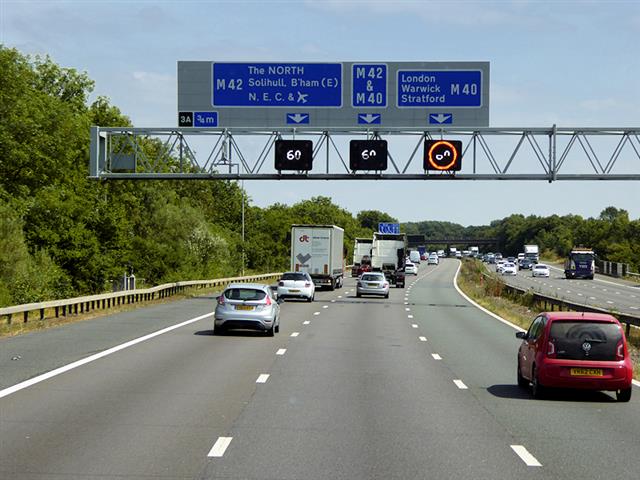
The clearest case for the fourth dimension is the structure that hangs over the road. A motorway sign gantry, a footbridge, an overhead signal frame: all are big slabs of metal, each throwing a radar echo as strong as any vehicle. A 3D radar picks one up dead ahead, fixes its range, watches the gap close as the truck drives toward it. By every reading the radar holds, this looks like a solid object in the path. The one reading that would clear it, that the structure sits five meters up with open road beneath, is the one the 3D radar does not have.
Treating that echo as an obstacle is how a radar-led system brakes for nothing. A phantom stop is dangerous in its own right, the more so on a commercial vehicle. A loaded truck that brakes hard for an imaginary obstacle invites the vehicle behind straight into its rear. The heavier the load and the faster the road, the worse a needless hard stop becomes. A truck on a trunk route meets more overhead metal than a car does, passing under gantries, bridges, height bars and tunnel mouths through the day, every one a fresh chance for a height-blind radar to cry obstacle over clear road.
This is not a rare edge case. Complaints of unexpected braking have run into the hundreds of thousands on driver-assistance systems built around radar that cannot read height. The structure overhead, the gantry and the bridge and the sign, is among the commonest things that set it off. A sensor that cannot tell up from down has no clean way to know the metal ahead is not in its path.
Height settles it at once. A 4D radar reads the same gantry echo and adds that it arrives from five meters up, well above the roofline of any truck. The system marks it as overhead structure and lets the vehicle drive on. The same logic clears bridges, overhead signs, tunnel mouths, anything the beam catches above the lane. What was a steady source of false alarms becomes a class of returns the radar can recognize and set aside.
The trick works within a range. Elevation angle separates a high structure from a low vehicle well when the target is reasonably close, inside the tens of meters where the geometry is favorable. Far out, the angle between a gantry and a car shrinks toward the radar’s resolution. The two blur again. Ground reflections add ghosts of their own, false returns that can read as if they sit below the road surface. A 4D radar shrinks the overhead-structure problem well short of erasing it.
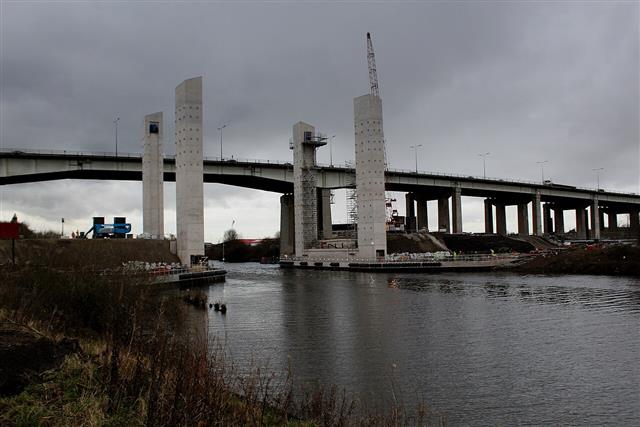
The overhead structure is a false alarm the radar should never have raised. The reverse failure is a real target the radar quietly drops. That one is deadlier. A car stopped in the lane ahead, halted by a breakdown or a crash or a jam, returns a radar echo like anything else. It sits perfectly still. Stillness is the one thing a 3D radar has trained itself to ignore. The habit is sound on its own terms. The world is full of stationary metal that means nothing to a moving truck: manhole covers, drain grates, road signs, crash barriers, the steel joints in a bridge deck. On a city street the radar may catch a fresh stationary echo every few meters, a sign, a pole, a parked car, a grate. A radar that alarmed at every one would cry wolf without pause. A driver would switch it off inside a mile. The radar leans on motion to survive, filtering the stationary world away to keep its warnings rare. A stopped car sits as still as a manhole cover. With only range, bearing, and closing speed to go on, the radar has no way to tell the two apart. They read alike, still and metallic and motionless. The stopped car gets discarded with the drain covers as the system rolls toward it. This is the notorious stationary-vehicle gap, the one behind a string of crashes where assisted vehicles struck stopped traffic at full speed. The fourth dimension breaks the deadlock. Heights tell them apart. A drain cover sits flat at road level. A gantry and a bridge clear four meters and more. A stopped car falls between, its echo coming from the height of a car, well off the ground and well below the structures overhead. Those bands sit far enough apart that even a coarse elevation reading, good only to a degree or two, can sort a return into road level, vehicle height, or overhead. On a truck the bands allow for ride height. A high cab and a tall trailer sit higher off the ground than a low car. The margins are set to suit. Once the radar reads elevation, stillness is no longer the only clue it holds. It keeps the still returns at vehicle height, out where a stopped car would stand. It drops the ones lying flat on the road or hanging high above. The height turns the choice of whether to trust a stationary echo from a guess into a judgment. That is what lets a radar keep the stopped car it once threw away and hand a braking system a target it can act on. The gap does not close all the way. The same range limit and ground-reflection ghosts still bite. What a commercial braking system then does with that target is a matter of its own. What changes here is only this: the stopped car is no longer invisible.
Height does more than sort returns into layers. A 4D radar with many channels returns a small cloud of points spread across the object. That cloud has a vertical extent. A tall thin column of points reads differently from a low flat smear. For the first time the radar carries a rough sense of an object’s shape, set above its bare position.
The cloud maps more than single targets. With points coming back from the road surface, the curbs, the barriers and the cars, a 4D radar can begin to sketch the free space ahead, the drivable channel between the obstacles. A 3D radar, blind to height, struggles to tell the open road from a low wall beside it. Reading elevation, the 4D unit marks what is clear to drive through and what stands in the way. It is a coarse map, far from a camera’s or a laser’s, useful all the same in the dark and the wet where those two falter.
That rough shape feeds classification. A standing pedestrian makes a compact, upright column of points. A low road sign sits in a short band near the ground. A rise or dip in the road spreads flat and wide. None of these is a clean picture. The vertical spread still gives a classifier something a flat 3D return never offered: a first cut at what kind of thing threw the echo.
The limits are real. A 4D point cloud is still sparse next to a laser scanner’s, which throws out far denser detail. Small targets suffer the worst of it, a pedestrian returning only a handful of points. The height resolution that sorts a car from a gantry is coarse, far below what a laser gives. A 4D radar sees shape the way a 3D radar sees position, a real step up, in blunt strokes.
Shape is still not identity. A cloud of points in the rough form of a person is a strong hint. The radar still cannot read the color of a brake light, the text on a sign, the painted line of a lane. Naming a thing for what it is stays the camera’s work, as the trade-off between the two sensors made clear. The fourth dimension gives the radar a better sense of where and a first hint of what. The full answer to what still comes from the camera.
None of this comes free. A second dimension of resolution is paid for in antennas. A 4D unit runs many more transmit and receive channels than a 3D radar. Spreading them across two planes means a larger, denser array on a bigger chip. More channels draw more power and more silicon. The sensor that sees height costs more to build than the one that does not.
The cost carries past the antenna. A dense point cloud is far more data than a short list of detections. Turning it into objects in real time asks for a stronger processor behind the sensor. The richer output must travel to the rest of the system as well, over the vehicle bus to the head unit, an integration question taken up where the 4D sensor is fitted as a product. More data and more compute, with more to move across the bus: the height dimension is no free upgrade to an existing radar.
Cost decides where it goes first. The 4D sensor lands first on the vehicles where the gain is largest and the budget allows: long-haul trucks, coaches, the higher trims of a fleet order. Lighter and cheaper vehicles stay on 3D radar, or on a camera with a plain radar behind it, carrying the older blind spots with them. As the chips fall in price the line moves down the range, the way vehicle electronics tend to spread, the costly feature of one year settling into the standard fit of a later one. Whether the extra cost pays back turns on the route a vehicle runs. A long-distance truck on fast roads in all weather meets stopped traffic and overhead structure as daily hazards, where the height dimension does real work. A low-speed urban van that rarely sees a motorway gains less from it. The sensor is a tool matched to a job.
For all it adds, the fourth dimension leaves the radar’s nature intact. A height reading is still not a name. The radar now knows a return sits at the height of a person, in coarse form like a person. It still cannot confirm whether the thing is a person or a post of the same size. Telling a pedestrian from a lamppost, a cyclist from a sign, stays the camera’s work. A 4D radar is a sharper radar.
The weather does not bend to it either. A 4D radar is still a millimeter-wave radar, working at the same frequencies as the 3D unit before it. It adds angles. Fog and cloud, with droplets far smaller than the wavelength, still pass almost untouched, the way they always have for radar. Rain is still the hard case. Raindrops near the size of the wave scatter it. The heaviest downpours still cut the radar’s range. The fourth dimension sorts returns in space. It does nothing to the physics of getting a return back through rain. A 4D radar reads height in weather that blinds a camera. It loses range in the same downpours a 3D radar does.
The old limits soften without vanishing. Angular resolution improves, staying coarse next to a camera’s. The reach is still finite, the elevation trick fading at long range as the angles close up. Ground reflections still throw their ghosts. A near blind zone sits close to the bumper, too tight for the beam to resolve. On an articulated truck a trailer can mask a corner radar through a sharp turn, a geometry no amount of elevation fixes. A 4D radar pushes some of these back a step. Others stay exactly where they were.
It is still a radar. Its point cloud stays thin and its shapes blunt next to what a laser scanner gives. A lidar reads three dimensions in fine detail already, at a price and with a weather weakness of its own, a third path taken up elsewhere. The 4D radar’s claim is narrower and practical: it brings useful height to the cheap, rugged radar a vehicle was already carrying.
Step back and the fourth dimension is a smaller, sharper idea than the name suggests. It gives back the one measurement the radar was always missing, the height that a row of antennas in a single plane could never read. With it, the two failures at the start lose their grip. The gantry overhead is known for what it is and left alone. The stopped car in the lane is held now, no longer dropped. Both came down to the one reading the radar had been missing.
The fourth dimension fills a gap the radar carried from the start. It was never the camera’s place to take.
A 4D radar is a millimeter-wave radar that measures four things about each target: range, horizontal bearing, closing speed and height. A conventional radar measures the first three and leaves height out. The fourth dimension is the elevation angle, how high above the road a return sits. It comes from spreading the radar’s antennas up the unit as well as across it. The unit can then resolve up-and-down position the way it already resolves left from right. The added reading is coarse, enough to sort a return by height, far from the detail of a camera.
The fourth dimension is height, read as an elevation angle. A 3D radar reads range, bearing and speed. It cannot read how high a return sits, because its antennas lie in a single horizontal row. A 4D radar adds antennas in the vertical direction, giving it a measure of elevation alongside the rest. That one extra reading lets it tell a thing on the road from a thing above it, the difference between a car in the lane and a sign gantry overhead.
Phantom braking often comes from a radar reading an overhead structure, a sign gantry or a bridge, as an obstacle in the path. A 3D radar sees the strong echo and the closing range. It cannot tell the structure hangs meters above the road. A cautious system may brake for nothing. A 4D radar reads the height of the echo and recognizes the gantry as overhead and clear of the vehicle. It leaves the gantry alone. Within a useful range it cuts this common false alarm sharply. Ground reflections and long distances still leave some hard cases.
Better than a 3D radar can. A conventional radar throws away stationary echoes as a rule, because it cannot tell a stopped car from a manhole cover or a bridge, all of which sit still with no height to separate them. This is the gap behind crashes where assisted cars ran into stopped traffic. A 4D radar measures the height of each echo. It can keep the ones at vehicle height in the road and discard the ones flat on the ground or high overhead. The stopped car stays visible. The detection is real. Range limits and ground ghosts keep it from being absolute.
No. A laser scanner, or lidar, builds a far denser and sharper three-dimensional picture than a 4D radar does. The radar’s point cloud is sparse by comparison. Its height resolution is coarse, good to a degree or two, well short of the fine detail a lidar gives. What the 4D radar offers is height on a sensor that is cheap, rugged and able to work through rain and darkness. A lidar costs far more and struggles in heavy weather. They sit at different points of price and ability.
Not for seeing through the rain. A 4D radar runs at the same millimeter-wave frequencies as a 3D one. Rain affects it the same way. Raindrops sit close to the wavelength in size and scatter the signal. The heaviest downpours shorten the radar’s range. What 4D radar improves is spatial: it tells high from low. It does not change the physics of getting a signal back through rain. The radar still holds its weather advantage, seeing in fog and darkness. The fourth dimension does nothing for range through a storm.