

An articulated vehicle breaks the one assumption every surround view rests on. The four cameras are calibrated in fixed poses relative to one another. The stitch that builds the overhead picture trusts those poses to hold. On a rigid truck they hold all day. On a tractor and semi-trailer they stop holding the moment the rig turns: the trailer pivots away from the cab at the kingpin, swinging its cameras through an arc the cab’s cameras never share. The seam where the cab picture meets the trailer picture tears as the wheel goes over. The honest answers are a live articulation angle fed back into the trailer’s geometry frame by frame, or a clear signal that the panel has stopped being true.
The earlier pages built the rigid case. The four-camera bird’s-eye, the fisheye calibration, the seam blending and the frozen homography all assume one fixed body that holds its shape. The pillar named the articulated case as the hard one and pointed at the kingpin, where that recipe runs out. A tractor and trailer is two bodies that share a picture, hinged at a point no camera sits on.
One fact reshapes the whole problem. A rigid van keeps its shape. Its four maps stay valid from one turn to the next, the way a hatchback’s do. A tractor changes its shape at the joint several times a minute in a yard. It swaps the entire rear half for a different trailer between jobs. The geometry the math page froze was frozen for a body that no longer stays still. The back of the picture belongs to a unit that may have coupled up an hour ago. The bend is the everyday state of a working rig. The picture has to be built around it.
The joint is where a commercial surround view stops being a car problem.
The overhead picture is built by mapping each camera’s pixels onto the ground through a homography, a fixed recipe for where on the flat plane every pixel belongs. The math page set out how that map is solved. What matters at the joint is when it is solved. The map is computed one time for a known camera pose and locked there. All four maps share a single rigid frame, the body the cameras are bolted to. A car has one body. That frame holds for the life of the calibration. A rigid truck is the same case, a longer car as far as the stitch can tell.
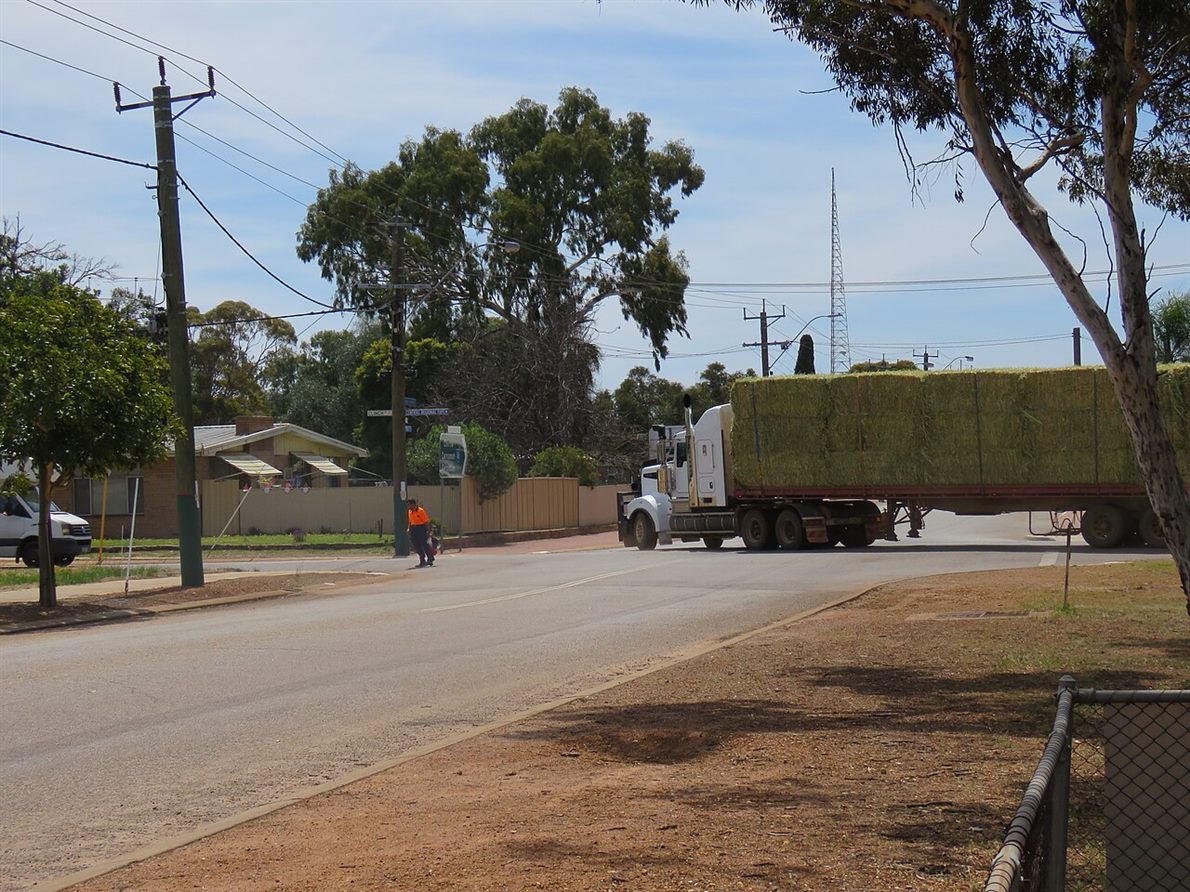
An articulated rig is two bodies. The cab cameras ride on the tractor. The trailer cameras ride on the trailer. Each body is rigid on its own. Its cameras hold their poses faithfully. The two bodies meet at the kingpin, the steel pin under the nose of the trailer that drops into the fifth-wheel plate on the tractor and lets the trailer swivel. The pin is the entire pivot. No camera sits on it or near it. The cameras are out at the corners of two bodies that swing about a point standing empty between them. The rig carries more cameras than a car’s four, a set on the cab and a set on the trailer, two rings that do not stay aligned.
The stitch that has to survive a turn is the overlap between the rearmost camera on the cab and the foremost camera on the trailer. On the straight, with the rig in line, those two views hand off cleanly, a painted line running unbroken out of one and into the other. That clean hand-off is what the calibration measured. It could capture one pose only, the rig dead straight, because a static calibration has no way to record a moving shape. The map trusts the trailer’s ground to stay where it sat when the rig was straight.
Every turn pulls that ground away. As the cab steers, the trailer swings about the kingpin. The foremost trailer camera rotates through an arc the cab camera does not follow. The two halves that lined up on the straight no longer belong to one frame. The stitch is now joining two pictures shot from poses the calibration never saw. This happens on every turn the rig makes, at the depot gate, the loading bay, the roundabout, dozens of times in a shift.
The bend has a number, the articulation angle, the angle between the cab’s center line and the trailer’s. Call it theta. With the rig straight, theta is zero and the two ground maps agree. As the cab turns in and the trailer follows, theta opens up. The trailer’s whole ground map rotates by that angle about the kingpin. The cab’s map stays put. The stitch is now asked to join a map that has turned to a map that has not.
The error this opens is not even across the seam. A ground point close to the kingpin barely moves when the trailer rotates, because it sits near the center of the turn. A point far out, at the back corner of a long trailer, swings through a wide arc, its position thrown off by roughly its distance from the pivot times the angle. The seam runs straight across this gradient. Near the pivot the two pictures still almost meet. Out toward the rim they stand a long step apart, the same rotation costing more the farther a feature lies from the pin.
On the screen the tear reads as a hard geometric break. A painted lane line runs cleanly down the cab panel and jumps sideways the instant it crosses into the trailer panel. A curb caught by both cameras draws twice, once where the cab map places it and once where the rotated trailer map places it, the two copies a hand’s width apart on the picture. A pallet or a person standing in the overlap splits into two faint figures that slide farther apart as the angle grows. The break is two correct pictures of a bent vehicle, drawn as if the vehicle were straight. A driver sees two curbs where one stands, or a figure that seems to drift, with no cue that a whole panel has rotated under a map still set for the straight rig.
The angle is not small. Anti-jackknife systems treat about twenty degrees as the edge of normal articulation. Full-scale jackknife studies have recorded angles past thirty-five degrees. A tight yard turn or a roundabout sits well inside that range, at tens of degrees off straight. A static stitch holds together only for the first few degrees. Every turn a working rig makes runs the joint far past where the frozen map stays true. The tear is the standing behavior of an uncorrected stitch. A showroom loop on a straight rig never puts it on screen.
The fix that keeps the stitched bowl through a turn feeds the live articulation angle back into the trailer’s map and redraws that half of the picture every frame. The mechanism is lighter than it sounds, because the trailer map does not have to be solved again. The static map was computed once for the rig dead straight, theta at zero. A bent rig differs from a straight one by a single rigid rotation, the trailer body turned by theta about the kingpin. The bent map is then the straight map followed by that rotation: the static trailer-to-ground map, its output turned about the pivot by the current angle. The expensive part, the calibration that ties each pixel to a ground cell, is done once and reused. The per-frame part is one rotation about a known point, the cheap end of the arithmetic. A system can bake this into the lookup table by holding a family of tables indexed by angle, or it can warp the already-projected trailer image by the rotation before the blend, either way avoiding a full re-solve of the geometry thirty times a second, which no embedded box has the budget for. What the method does demand is a calibration the rigid case never needed: the position of the kingpin in the trailer cameras’ own frame, the point everything turns about. A wrong pivot turns the rotation about the wrong center. The seam then closes at one angle and gapes at another, the correction becoming its own source of error. The harder demand is timing. The angle has to arrive and the re-warp has to finish inside the same frame the cab image is drawn in, because a trailer panel redrawn for an angle the rig has already swung past tears the seam the opposite way, the panel lagging the bend it should be tracking. A stale angle is its own failure. It stacks straight onto the glass-to-glass budget the latency page set out: sensor delay, estimation delay and the warp, all inside one frame. When the angle is clean and current, the bowl holds together through the turn, the painted line crossing the seam unbroken as the rig bends. When the estimate slips, from sensor noise or a vision tracker losing its hold, the trailer panel wanders. A seam that moves is worse to read than one that sits still in the wrong place, because the eye is pulled to motion. The re-warp buys back the through-turn bowl. It asks for compute, a pivot calibration and an angle that is both accurate and on time, every frame the wheel is turned.
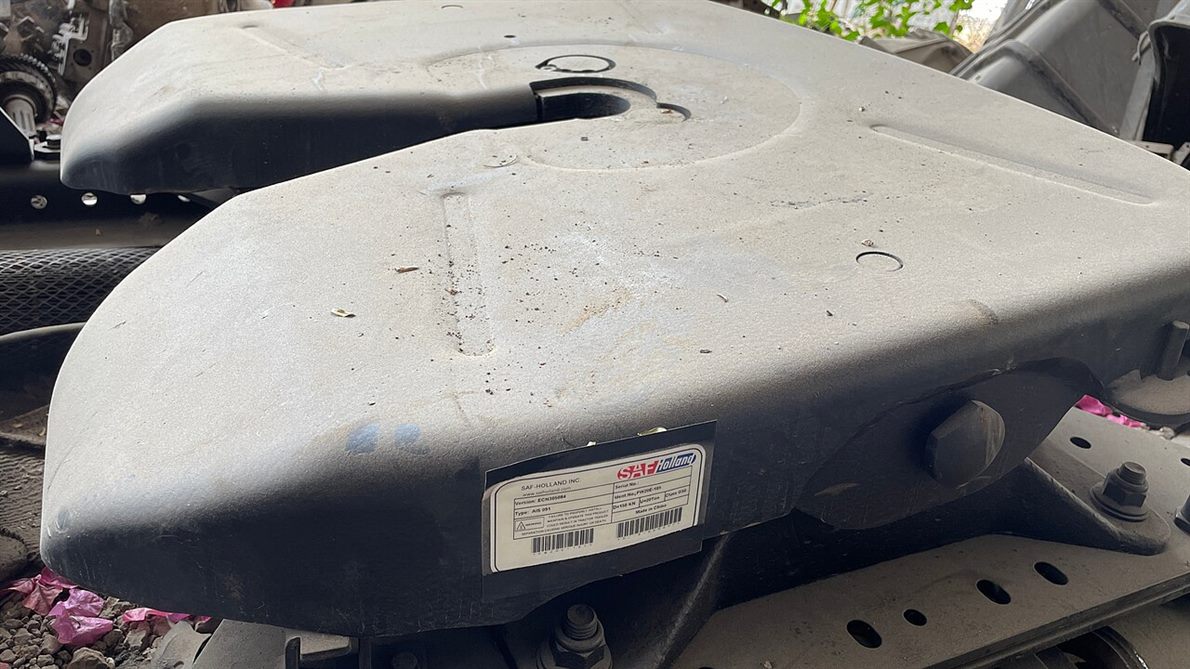
The re-warp is only as good as the angle it is fed. That angle comes from one of three places. The choice shapes how well the bowl holds through the turn. The cleanest source is a sensor at the coupling. A fifth-wheel angle sensor reads the rotation of the kingpin against the plate, through a Hall-effect pickup with a magnet on one half and a sensor on the other, a floating-rotor potentiometer, or a laser reading a height-stepped strip cut in a semicircle about the pin. Any of them hands the system the true angle directly, with low delay and no scene to interpret.
The sensor has a catch. It lives on the coupling. A tractor running a drop-and-hook operation meets a different trailer through the shift, some sensored and some bare. A sensor on the tractor’s own fifth wheel reads the plate rotation and survives every swap. One that leans on a target fixed to the trailer goes blind the moment an unequipped trailer drops on. A fleet that owns its trailers can trust the signal. A fleet that pulls whatever sits in the yard cannot.
The second source is the cameras already on the rig. The trailer cameras that build the picture can be read to estimate the angle, sparing a sensor and a wiring run. A tracker follows the cab in the trailer camera’s field, or matches features across the seam, or a learned model reads the pose straight from the image. Published systems do all three. The estimate needs no extra hardware, at the cost of latency, the angle now waiting on a frame of processing. It weakens in the dark, in glare and in low-texture scenes where the tracker finds nothing to hold, the conditions the night and weather pages set out. At a wide angle the cab swings clean out of the trailer camera’s field. The estimator then loses the thing it was tracking.
The third source rides on the vehicle bus already, the steering angle, free to read and instant. The steering angle is not the joint angle. Steering sets where the cab points. Articulation is how far the trailer has swung. It trails the wheel. Off-tracking, the gap between the cab’s path and the tighter line the trailer cuts, keeps the joint bending after the wheel stops and unwinding after it straightens. The trailer angle matches what steering predicts only on a steady-state circle, a state a real turn passes through for a moment. Steering works as a cheap trigger that a turn is under way. As the degree-accurate input the rotation needs, it falls short. The stronger designs read steering to arm the response and a sensor or vision estimate to set the angle itself.
Re-warping is the answer when the angle is good. Sometimes it is not. The sensor drops out, the vision tracker loses its lock at a wide angle, or the compute runs short under load. A system that keeps re-warping on a bad angle draws a confident wrong picture, the worst result of all. The honest move at that point is to stop stitching the trailer and say so.
The decision turns on a threshold angle. A small bend leaves the static stitch close enough, the seam error inside the width the picture can absorb. Below a few degrees the system leaves the frozen map alone. Past that, the error grows beyond what the display can carry. The panel has to be corrected or dropped. Where the line sits depends on the job the screen does, tighter for a close parking view than for a rough read of the nearside.
Dropping the stitch takes three forms. The system can freeze the last good stitched panel and hold it, keeping a familiar picture on screen by showing the past as if it were now. It can blank the trailer half, an honest gap that loses the view where the driver may want it. It can switch the trailer region to the raw feed of one trailer camera, a fisheye view, no longer a tidy overhead, live and geometrically true as far as it reaches. The third is usually the soundest, a real view of the trailer side with no stitched fiction laid over it.
The form matters less than the signal. A fallback panel that looks identical to a live stitched one invites the driver to trust it. A frozen or single-camera view taken for a true overhead is the real hazard. The panel that has stopped being a true stitch has to look different, a colored border, a dimmed image, an icon, anything that reads at a glance as this half is not the live bowl. The weather page made the same point about a fouled lens. It holds here too: a picture that has stopped being a true stitch is safe only when it shows that it has.
Timing decides whether a freeze is allowed at all. A dropout of a frame or two can ride on the last good panel without harm, the bend barely moving in that time. A sustained loss cannot, since the rig keeps bending while the picture sits still, the error growing every frame. A freeze has to be bounded by a timer that gives up and falls to the live single-camera view once the gap runs long. The cheapest systems skip the re-warp and go straight to single-camera past the threshold. That is a fair design on its own terms, as long as the switch is visible. The fault is the silent fallback.
The re-warp needs one number the rigid truck never had to find, the position of the kingpin in the trailer cameras’ own frame. That pivot is what the rotation turns about. It is a property of the trailer, carried by that trailer. A drop-and-hook tractor changes trailers through the day. Each trailer carries its cameras at its own heights and offsets. The pivot that was right for the morning’s box is wrong for the afternoon’s. The calibration regimes page set out the one-time against live fork. The swapping fleet is where that fork cuts deepest, because there is no fixed rear body to bake a calibration against.
A system has three ways to cope. It can identify the trailer. A tag broadcast by the trailer, or a code read at the coupling, names which one dropped on. The stored calibration for that trailer loads, pivot and all. Those numbers can live on the trailer’s own electronics and cross to the tractor when the units connect. A trailer the cab has never met then arrives carrying its own calibration. It can re-derive the geometry live. The same vision that estimates the angle recovers the relative pose of the trailer cameras, calibrating the box afresh on every coupling. It can accept that on an unknown trailer the overhead view drops to the single-camera fallback, the stitch held back until the box has a pivot it trusts.
Self-calibration is not instant. The vision that recovers the pivot needs the rig to move and turn before it can read the geometry it is solving for. A box that calibrates over the first minute of driving is still converging through the yard maneuver right after coupling, the low-speed turn the overhead view is built for. The view is least settled at the moment the driver first reaches for it. Storing a known trailer’s calibration and loading it on coupling avoids that wait. A box that solves from scratch lives through it on every hookup.
Which path a system takes is the question to put to a vendor whose demo truck wears one fixed trailer. A clean overhead on a single rigid combination shows nothing about the swap. The real test is the second trailer, the one the system has never seen, coupled in the yard. A unit that handles that case has solved the part that matters to a working fleet.
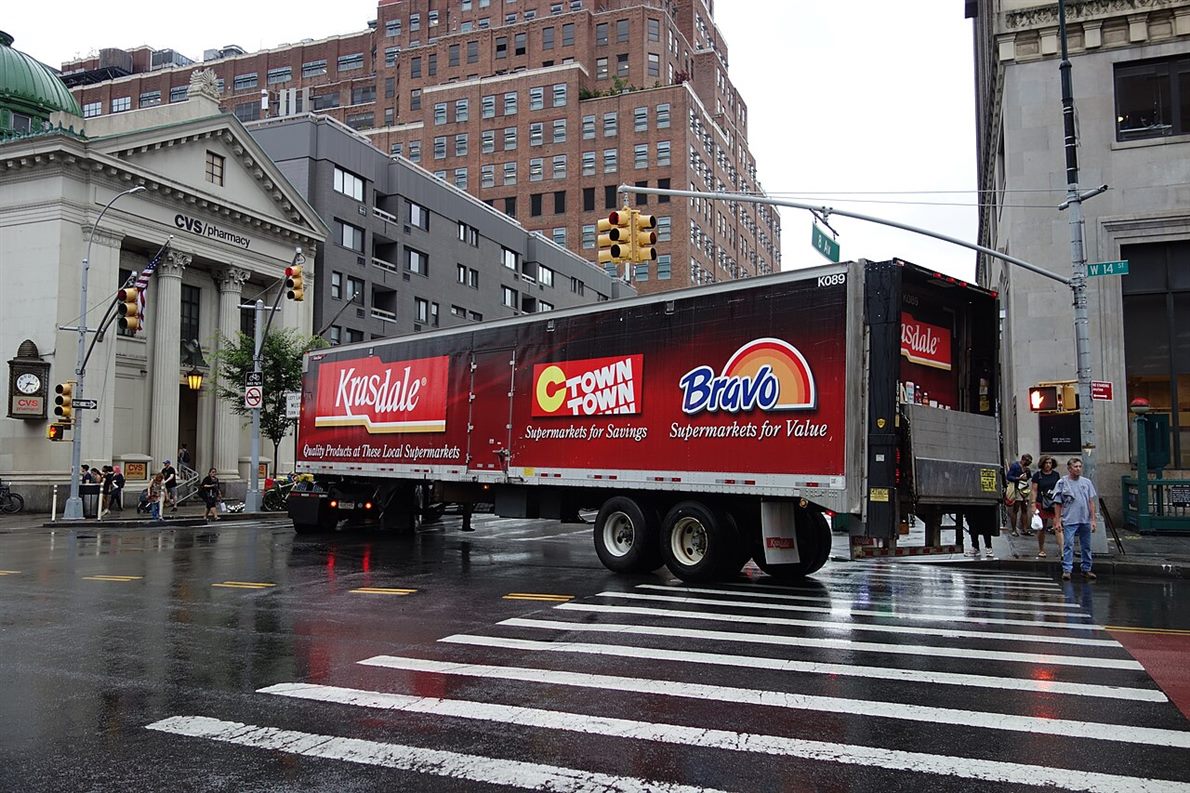
The seam that tears mid-turn sits over the deadliest ground around the vehicle. As a tractor and trailer turns, the trailer off-tracks, its rear wheels following a tighter circle than the cab’s. The inner gap does not stay open. It sweeps across the nearside as the rig comes round, over the curb where people wait. That inner sweep is the zone a cyclist or a pedestrian is caught in, the space between cab and trailer closing on anyone at the inside of the turn. It is the blind spot behind a long line of heavy-vehicle turning deaths.
The view meant to show that space is the one that fails there. The inner-radius seam is exactly the cab-to-trailer overlap, the part of the picture bending hardest as the rig turns. The picture is least trustworthy at the one spot where a missed figure is a fatality. A doubled or torn panel over the inside of the turn can hide the person the system was fitted to reveal.
No camera sits on the kingpin to watch the closing gap directly. The inside of the turn is covered only by the overlap of the cab and trailer cameras, the overlap that tears. The cab cameras alone cannot see down the trailer’s inner flank. The trailer carries its own set. Their join to the cab view has to hold through the bend. Mirrors never showed this gap well, the reason the nearside of a heavy vehicle now carries cameras and sensors at all. The surround view is the tool meant to make the inner radius visible. The driver checks it in the middle of the turn, hands on the wheel, with no spare second to doubt it. It has to be right at that moment, or honestly blanked. A faint seam is a cosmetic fault over open tarmac and a safety failure over the inside of a turn.
Four questions put the joint on an order sheet. The first is whether the system corrects the trailer panel through a turn at all, or only freezes or blanks it past a few degrees. The second is the angle source, a coupling sensor, a vision estimate, or steering arming a fallback. The third is the behavior past the threshold, a live re-warp or a clean drop to single-camera, with that drop signaled on screen. The fourth is the unknown trailer, what the picture does when a strange box couples on.
One joint is the single semi-trailer. A drawbar combination or a B-double adds more joints. The picture stops being one bowl then, a separate problem of switching between the segments. For the common tractor and semi, one test settles it. A hard turn in the yard, on a trailer the system has never calibrated, with the inner-radius seam watched as the rig bends, shows whether the joint is handled or only hidden.
The stitch that builds the overhead picture is calibrated for four cameras in fixed positions, one rigid body. A tractor and trailer is two bodies hinged at the kingpin. When the rig turns, the trailer swings about that pin and its cameras rotate through an arc the cab cameras do not follow. The two halves of the picture were aligned only for the straight rig. Once it bends, the trailer panel no longer lines up with the cab panel. A painted line steps sideways at the seam. A curb caught by both cameras draws twice.
It feeds the live articulation angle back into the trailer’s map and redraws that half every frame. The trailer map does not have to be solved again. A bent rig differs from a straight one by a single rotation about the kingpin. The corrected map is the static map turned by the current angle about the pivot, cheap arithmetic done per frame. The method needs the pivot’s position in the trailer cameras’ frame. It needs the angle fresh, because a stale angle redraws the panel for a bend the rig has already passed and tears the seam the other way.
From one of three places. A sensor at the fifth wheel reads the kingpin’s rotation directly, through a Hall-effect pickup, a potentiometer, or a laser, for a clean low-delay angle. The cameras themselves can estimate it, sparing a sensor. The estimate adds processing delay and struggles in the dark or at wide angles where the cab leaves the trailer camera’s view. The steering angle is free to read. It is not the joint angle, because the trailer lags the cab through a turn. Strong systems use steering to arm the response and a sensor or vision estimate to set the angle.
It should stop stitching and show that it has. The choices are to freeze the last good panel, to blank the trailer half, or to switch that region to the raw feed of one trailer camera. The single-camera view is usually the soundest, a live and geometrically true picture, no longer a tidy overhead. Whatever the choice, the fallback panel has to look different from a live stitch, by a border, a dimmed image, or an icon, because a frozen or single-camera view trusted as a true overhead is the real hazard.
The re-warp depends on where the kingpin sits in the trailer cameras’ frame. That pivot belongs to the trailer. A new trailer carries its cameras at different heights. The old pivot is wrong for it. A system copes by identifying the trailer and loading its stored calibration, by re-deriving the geometry live from the cameras, or by dropping to the single-camera fallback until it has a pivot it trusts. Self-calibration takes a little driving to converge. The picture can be least settled during the yard maneuver right after coupling, the low-speed turn it is built for.
Because the seam that tears mid-turn sits over the deadliest ground around the truck. As the rig turns, the trailer off-tracks and its wheels cut inside the cab’s path, sweeping the nearside curb where a cyclist or pedestrian stands. That inner radius is the cab-to-trailer overlap, the part of the picture bending hardest and tearing worst. The view is least trustworthy at the one spot a missed figure is a fatality. Keeping that seam true through the turn, or honestly blanking it, is the difference between a cosmetic fault and a safety one.