



JT 1242 is the Chinese standard for the automatic emergency braking system on a working bus or truck. It sets what the system must detect, how hard it must brake, and the staged tests a vehicle has to pass before the brakes may act on their own.
JT/T 1242, in full JT/T 1242-2019, published in March 2019 and in force from that July, is the performance and test standard for the automatic emergency braking system on operating vehicles. The system it governs watches the road ahead, judges when a collision has become unavoidable on the driver’s input alone, then applies the brakes itself to stop the vehicle or cut the speed of the impact. The standard fixes the general requirements, the functional requirements, the environmental ones, and the test procedure that proves the system behaves. A buyer who reads JT 1242 on a datasheet is looking at a claim about a braking system that acts without the driver; a camera or a warning buzzer is a different kind of claim.
The word that separates this standard from its neighbour is braking. A warning system tells the driver to act. The system under JT 1242 acts when the driver does not. That difference of control is why automatic emergency braking carries its own standard, its own tests, and a far heavier burden of proof than a system that only sounds an alarm.
An automatic emergency braking system divides into the same parts the standard does: the sensing that watches the road ahead, the staged response that runs from alert to full braking, the engineering that keeps both reliable on a vehicle whose weight can triple between trips. JT 1242 writes requirements against each part in turn, then proves the whole on a track, with defined scenarios standing in for the crashes the system exists to prevent.
JT 1242 governs a system that takes over the brake pedal in the last moment before a crash. The chain it covers runs in stages. The system tracks the vehicle ahead, judges the closing speed against the gap, warns the driver when a collision is coming, then brakes on its own if the driver has not reacted in time. The final act, the braking, is the part that sets this standard apart. A warning system never touches the controls of the vehicle. The system under this standard applies the brakes itself.
That power is why the standard is built the way it is. A system that brakes a forty-tonne truck without being asked has to be right almost every time, since a brake it should not have applied is its own kind of danger on a motorway. The standard answers that with two demands. The system must brake hard when a crash is coming. It must stay still when the danger is only apparent. The bulk of the engineering and the testing addresses the space between those two demands.
The system reads the road ahead through a forward radar, a camera, or the two working together. The radar measures the distance to the vehicle ahead and the rate at which the gap is closing. The camera reads what the object is, whether a car, a truck or something at the roadside that the vehicle will pass without harm. A system that fuses both is harder to fool than either alone, the reason higher-grade units carry the pair.
From those readings the system works out the time to collision, the seconds left before the vehicle would reach the object if nothing changed. Time to collision is the number the whole response is built on. A large gap closing slowly leaves time for a warning. A small gap closing fast leaves time only for the brakes. The system measures that figure many times a second, watching for the moment it drops past the point where a warned driver could still stop in time.
The two sensors fail in different ways, the case for pairing them. A camera loses the road to fog or heavy rain or the glare of a low sun on a wet surface. A radar holds its reading through that weather. It can still be fooled by a metal object off to the side or an overhead sign that throws back a strong echo. Fusing the radar’s range with the camera’s read of what the object is gives the system a judgement neither sensor reaches on its own. On a heavy vehicle, where a needless hard stop is its own hazard, that combined judgement decides whether a fleet trusts the system to act or switches it off.
The response comes in stages, for a plain reason. The driver should always have the first chance to act. So the system warns first, with a sound and a light, at the point where a collision is coming with room to brake still left. If the driver brakes, the system stays out of the way. If the driver does nothing as the gap keeps closing, the system moves to partial braking, slowing the vehicle inside the margin that remains. If the collision becomes unavoidable on the driver’s input alone, the system applies full braking to stop the vehicle or to shed as much speed as the distance allows.
Each stage buys back a slice of the time the driver’s inattention spent. Even where a crash cannot be avoided outright, the speed the system sheds in those last seconds changes everything about the impact. A collision at thirty kilometres an hour is a survivable event where the same crash at seventy is not. The standard treats this speed reduction as a real outcome in its own right, since on a heavy vehicle the difference between a hard stop and a slightly softer one is measured in lives.
The timing of those stages is the core of the design. The warning has to come early enough that a driver still has the distance to stop, late enough that it does not call danger at every car ahead. The partial braking begins with a margin still in hand, firm enough to count for something. The full braking commits only where the system judges the collision unavoidable on the driver’s input alone. Each threshold is a figure the standard pins down for a vehicle whose stopping distance is long, since a window tuned for a car closes too late for a loaded truck.
The brakes act only after the warned driver has not.
Automatic braking on a passenger car faces an easier task. The reason an operating vehicle needs its own standard sits in physics that a car never faces. A loaded truck carries a mass that takes a long way to stop, far longer than a car at the same speed, so the system has to begin acting earlier to make any difference at all. The brakes themselves are air brakes with a lag the system has to allow for, a delay between the command and the wheels biting that a car’s hydraulic brakes do not share. The weight shifts forward hard under heavy braking, loading the front axle and lifting the rear, a behaviour the system has to brake through without losing control of a long vehicle. A coach adds standing passengers who can be thrown by a sudden stop, so the deceleration has to be firm enough to matter, controlled enough not to cause the harm it is meant to prevent. Every one of these makes the operating-vehicle case harder than the car it borrows its sensors from. Every one is a reason the threshold and the braking profile cannot be lifted wholesale from a passenger-car rule. The standard sets the bar for a vehicle whose stopping distance is long, whose brakes are slow to bite, whose load shifts under the stop, and whose cargo or passengers feel every newton of the deceleration. That is the engineering JT 1242 is written to govern. It is why the figures inside it carry the mass of the vehicle they apply to. The brakes themselves add a delay a car never deals with. Air brakes take a moment to build pressure after the command, a lag of a fraction of a second that, at motorway speed, is several metres of road the system has to anticipate. The deceleration it can safely demand is bounded too, held below the point where a long vehicle would lose its line or a coach throw its standing passengers. The system works through the vehicle’s anti-lock braking, taking off speed as hard as the grip allows without locking a wheel. None of this lives in a passenger-car system. It is why a heavy-vehicle braking standard is written separately at all, its thresholds and its braking profile set for the mass, the brakes and the handling of the vehicle it governs; numbers borrowed from a lighter one do not transfer.
A commercial vehicle is rarely the same weight twice. A truck runs out loaded and back empty, a coach fills and empties at every stop, so the mass the braking system has to manage swings across a wide range through a single day. An empty truck stops in a fraction of the distance a full one needs, from the same speed, which means a braking profile tuned for one is wrong for the other. The system has to read the vehicle it is in at that moment, not the vehicle on the datasheet. A system that brakes an empty truck on loaded settings locks the wheels and slides. A system that brakes a loaded truck on empty settings fails to stop it in time. The standard pins the envelope accordingly: the system has to work from 15 kilometres per hour up to the vehicle’s top design speed, under every load condition the vehicle is rated for.
This is part of why the standard tests the system on the vehicle itself; a bench alone cannot answer it. The interplay of the braking system with the load, the suspension and the road is the real test, the thing a laboratory chamber cannot fully recreate. A fleet that fits a JT 1242 system to a mixed fleet of weights is trusting the engineering to handle the range, the central problem the standard sets out to bound.
The test procedure stages the collisions the system is built to prevent. A target vehicle sits stationary in the lane, the case of a queue at the end of a jam, with the test vehicle closing on it at speed. A target vehicle travels ahead at a steady, lower speed, the case of slow traffic the driver has not noticed. A target vehicle brakes in front, the case of a sudden stop in the flow. For each, the test checks that the warning fires at the right moment, that the braking follows when the driver does not act, then that the speed at impact, where an impact still happens, falls within what the standard allows.
Running these on a heavy vehicle is its own undertaking. The speeds are real, the masses are real, the system that brakes late or not at all found out on the track before it ever reaches the road. A device passes by behaving correctly across the set of staged collisions, not by listing the function on a page. The shape mirrors the international rule for the same equipment, UN Regulation 131, which writes a collision warning phase followed by an emergency braking phase into heavy-vehicle type approval; a maker selling into both markets engineers one staged system to clear two papers. This is the line between a datasheet that claims automatic braking and a system shown to brake a loaded vehicle to a stop at the right moment, the evidence a careful buyer looks for.
The speeds in the test are chosen with care. They span the range at which a heavy vehicle’s collisions turn serious, from the moderate closing speed of slow traffic to the higher speed of a vehicle bearing down on a stationary queue. The pass mark is set in terms of the speed left at impact where an impact still occurs, since on a heavy vehicle a stop that sheds forty kilometres an hour before contact is a real result. A system is measured on how much speed it takes off, against the speed it would otherwise carry into the crash, because the harm a heavy vehicle does climbs steeply with that figure.
The test fixes the conditions too, so a pass means the same thing from one lab to the next. The target, the approach, the road surface, the brake temperature at the start: each is set down, so a result on one track can be trusted on another. A figure that shifted with the weather of the test day would tell a buyer nothing. Pinning the conditions is what makes the number the test produces mean something a fleet can act on.
The risk built into every automatic braking system is the false brake, the hard stop applied when nothing was wrong. On a passenger car a false brake is alarming. On a forty-tonne truck on a motorway, a hard stop for a phantom can cause the same pile-up the system exists to prevent, with the traffic behind given no warning at all. The standard’s performance requirements are drawn as much around this failure as around the missed collision. The system has to tell a real obstacle from a steel plate in the road, a stopped car in the next lane, an overhead gantry that radar can mistake for a wall, a vehicle turning out of the path. Sorting the genuine threat from the look-alike, fast enough to still brake in time for the real one, is the hardest single thing the system does. A unit that brakes too readily trains its driver to switch it off, the one outcome that takes away the protection the standard exists for.
Guarding against the false brake shapes the whole sensing design. The system holds the brakes back until the radar and the camera agree a real obstacle sits in the path. It tracks an object across several readings before acting, so a brief spurious echo never triggers a stop on its own. Reading the road geometry lets it tell an object in the lane from one on a curve the vehicle will follow away from. None of this shows on a spec sheet. All of it decides whether the system brakes for the truck ahead, then stays still for the gantry above.
A braking system is worthless if it works only on a test track in mild weather. The standard carries environmental requirements so the system holds up in the conditions a working vehicle meets: the heat of a cab in summer, the vibration of a chassis over years, the supply voltage that sags and spikes as a diesel engine cranks. A radar caked in road salt or a camera blinded by a low sun is a system that has stopped seeing, at the moment it may be needed. The standard asks the system to keep working across that range, or to tell the driver clearly when it cannot, since a system that fails without warning is more dangerous than one a driver never leaned on.
The sensors set the honest limits here. Heavy rain, fog and snow cut the range a camera reads. A radar holds up better through weather without being immune to it. A system built for real operating conditions leans on more than a single sensor, the reason the better units pair radar with a camera. A buyer who runs vehicles through hard winters does well to ask how a system behaves when its sensors lose part of their range, the condition under which a working vehicle spends a real part of its life.
A fail-safe question runs underneath all of this. A braking system that quietly stops working is more dangerous than none, since the driver has come to rely on a backstop no longer there. So the standard requires the system to know when it can no longer see and to fall back to warning the driver, announcing its own failure. A camera fouled by mud or a radar iced over has to announce that it cannot see. How a system behaves when it fails is as much a part of the standard as how it behaves when it works.
The sensors need keeping clean to keep seeing. A radar behind a bumper packs with road salt over a winter, a camera films over with the same grime that coats the windscreen. A system unaware of its own dirty sensor brakes late or not at all, with no sign to the driver that the sensor no longer reads the road. So the care of the sensors becomes a maintenance item, checked on the same schedule as the rest of the safety kit.
Recalibration belongs on that same schedule. A forward sensor knocked out of aim by a minor bump reads the wrong piece of road, braking for a lane the vehicle is not in or missing the one it is. The standard reaches the fitting for this reason. A fleet that takes the system seriously checks its aim on a schedule, never trusting it to hold for the life of the vehicle.
JT 1242 does not stand alone on a vehicle. It assumes a braking foundation underneath: the standard is written for vehicles already carrying anti-lock braking, electronic stability control and disc brakes on every wheel, so the automation sits on hardware that can deliver the stop it commands. It works alongside the warning standard that covers forward collision and lane departure alerts, the two forming a layered defence. The warning layer gives the driver the first chance to act. The braking layer catches the case where the driver does not. A vehicle may carry both, the warning system raising the alarm and the braking system stepping in only when the alarm goes unanswered. The two share sensors often enough. They answer to separate standards because they make a different promise, alerting the driver in the one case and acting for the driver in the other.
Reading the two together shows the shape of the safety case. A warning with no braking behind it depends entirely on a driver who may be asleep. Braking with no warning before it removes the driver’s chance to handle the situation themselves. The pair, warning first and braking as the backstop, is the arrangement the regulation builds toward, each standard governing its own half of the response.
The order matters alongside the pairing. Warning first gives the driver the chance to act. Braking second steps in only once that chance has passed, never before. The standard builds the layers in that order on purpose, with the warning as the first layer and the braking held behind it.
The standard’s limits matter as much as its contents. JT 1242 covers automatic braking in line with the vehicle ahead. It does not turn the vehicle to avoid a crash, a different and harder problem the standard leaves alone. It does not govern the video recorder the system may sit beside, nor the upload of an alarm to a regulator’s platform, each its own standard. It does not promise to prevent every collision, only to prevent or soften the ones its sensors can see forming in time. A vehicle fitted to JT 1242 still crashes if a child runs out a metre ahead, or if a car cuts in with no gap left to brake.
So a purchase that leans on JT 1242 alone has covered one layer of a larger case. The system brakes for the collision it can see coming down the lane. The warning, the recording, the upload, the side and rear hazards the forward sensors never watch: each is a separate requirement with its own standard. A fleet that reads a JT 1242 line as a complete safety package has taken one true thing and assumed several others.
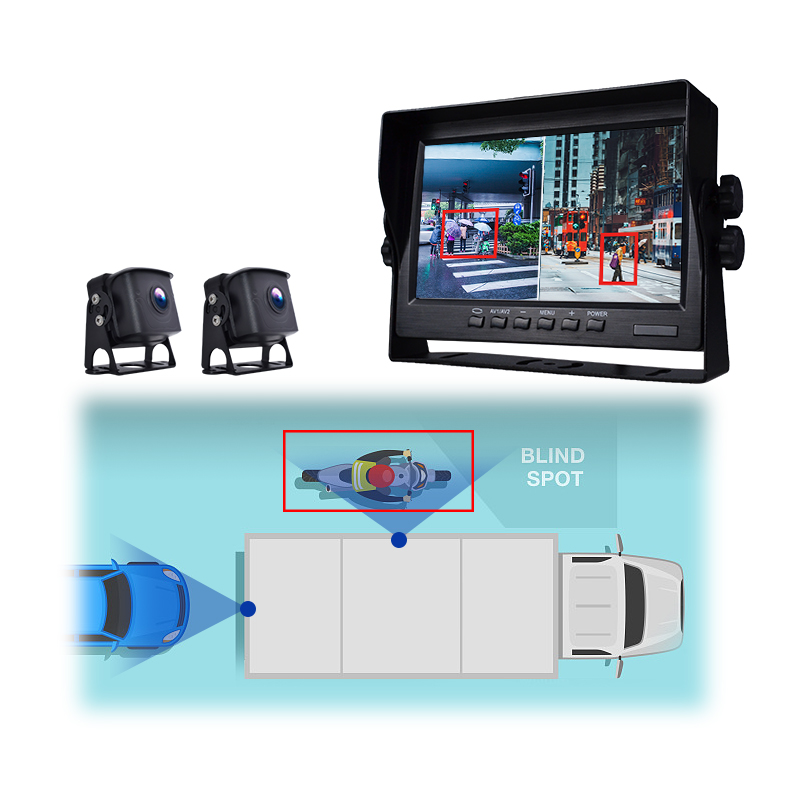
The side and rear are the clearest gap. The forward sensors that feed JT 1242 watch the lane ahead, the place a following collision forms. They see nothing of the blind spot down the right side where a cyclist sits, nothing of what crosses behind on a reverse. Those hazards belong to other systems and other standards, the blind-spot and reversing aids a vehicle carries alongside. A buyer who reads forward automatic braking as all-round protection has mistaken cover of the lane ahead for cover on every side.
For an operator fitting coaches or trucks, JT 1242 is the standard to check for the automatic braking system, read together with the warning standard for the alerts. A unit that meets it, with the test evidence behind it, will brake a loaded vehicle to a stop or shed real speed at the right moment, holding its false brakes low enough that drivers leave it switched on. A cheap unit that claims the function without the performance behind it fails on the road, the failure showing as drivers switching off a system that has lost their confidence.
Treat automatic braking as one layer; hold it to its own evidence. Confirm the JT 1242 system is genuine, tested on the kind of vehicle and load it will carry, with the false-brake behaviour proven as carefully as the stopping. Then ask the separate questions about warning, recording and the hazards the forward view never sees. The braking system is the final layer of an operating vehicle’s safety case, the one that acts when every earlier chance has passed. A buyer who holds it to its own standard, without mistaking it for the whole, gets the layer the regulation intended.
JT/T 1242-2019 is the Chinese performance and test standard for the automatic emergency braking system on operating vehicles. It sets what the system must detect, how it must brake, the environmental conditions it has to survive, the test procedure that proves it works. It governs a system that brakes the vehicle on its own; a warning device is a different category.
JT 883 covers warning systems that alert the driver, including forward collision and lane departure warnings. JT 1242 covers automatic emergency braking, which acts on the vehicle when the driver does not. One alerts, the other brakes. A vehicle often carries both as a layered defence, with the warning first and the braking as the backstop.
No. JT 1242 covers braking in line with the vehicle ahead, within what the sensors can see forming in time. It does not steer to avoid a crash; it cannot prevent a collision where a hazard appears with no room left to brake. It prevents or softens the collisions it can see coming, which on a heavy vehicle is a large share of the serious ones.
A loaded truck or coach has a long stopping distance, air brakes that lag, a load that shifts under braking, passengers or cargo that feel the deceleration. The system has to begin acting earlier and brake in a controlled way that a passenger-car system is not built for. The thresholds and braking profile carry the mass of the vehicle, so they cannot be borrowed from a car rule.
A hard automatic stop applied when nothing was wrong can cause a pile-up on a motorway, since the traffic behind gets no warning. The standard’s performance requirements guard against this as strictly as against a missed collision. A system that brakes too readily trains its driver to switch it off, which removes its protection entirely.
No. JT 1242 covers the automatic braking layer only. Warning systems, video recording, the upload of alarms to a platform, the side and rear hazards the forward sensors never watch: each has its own standard. A JT 1242 system is one layer of the safety case; a buyer checks the others separately.