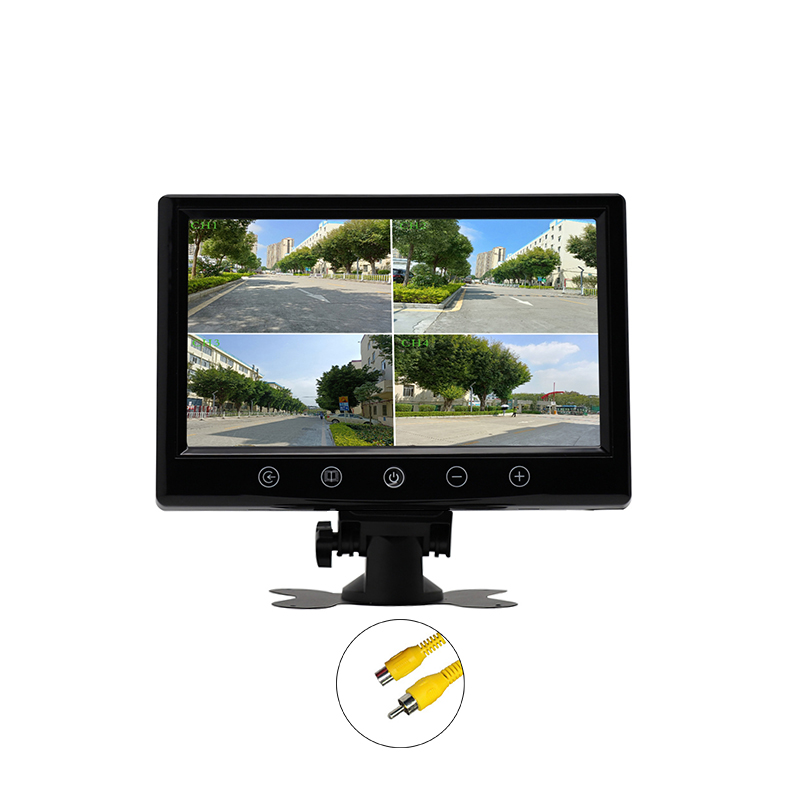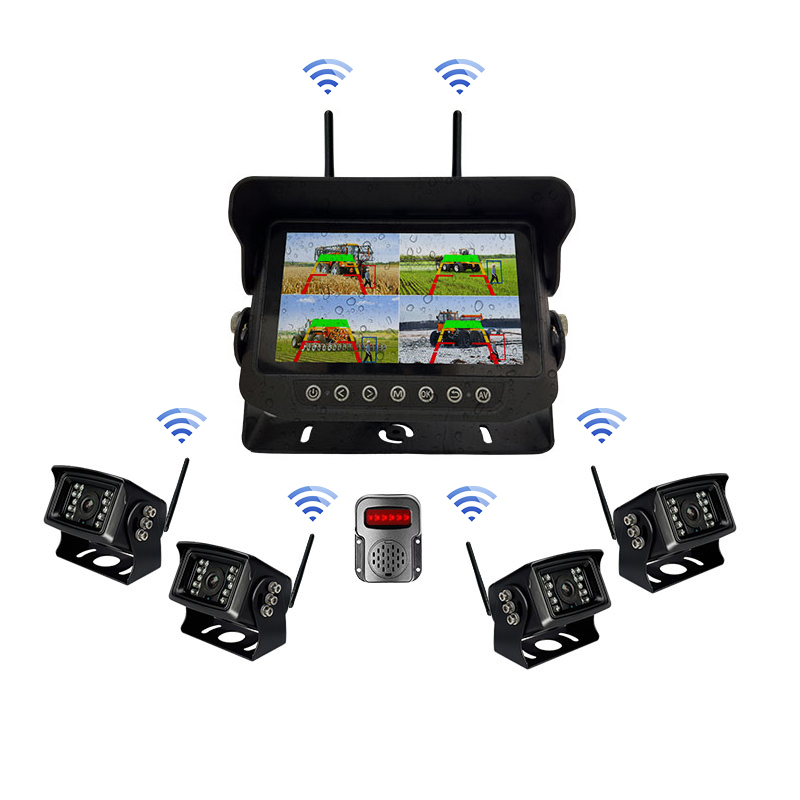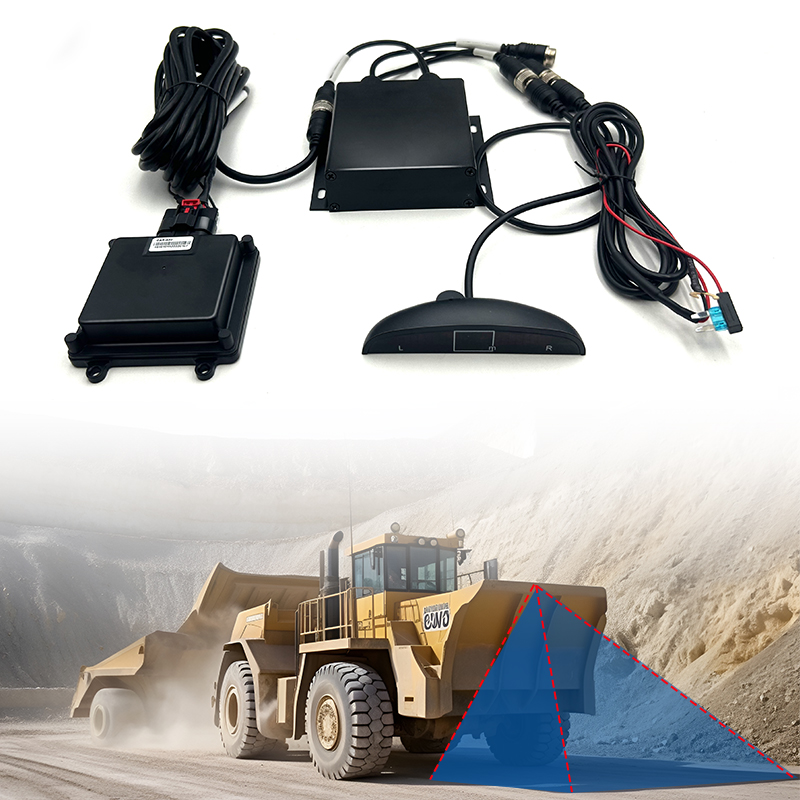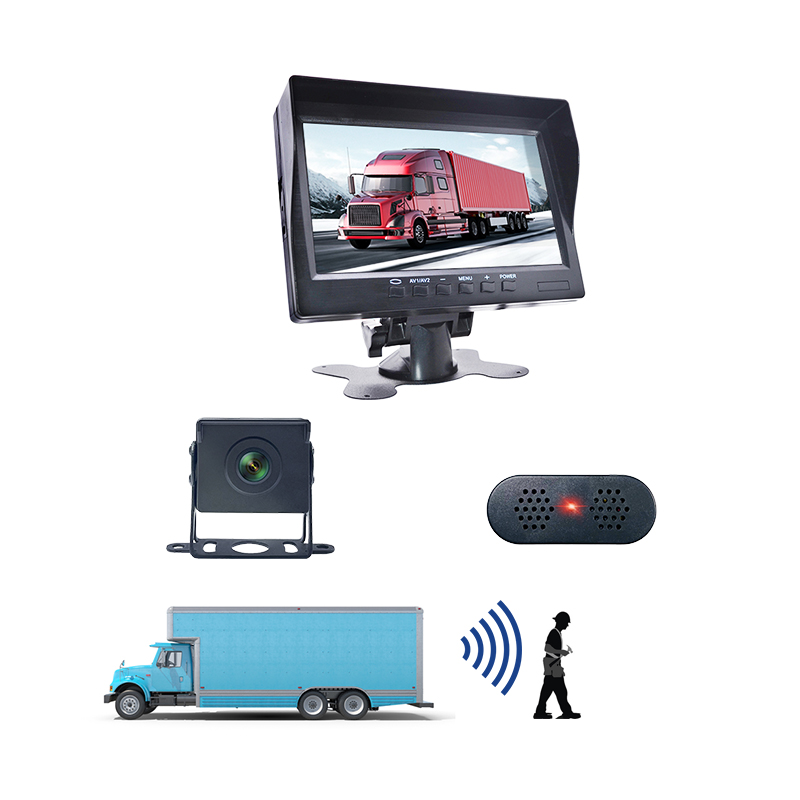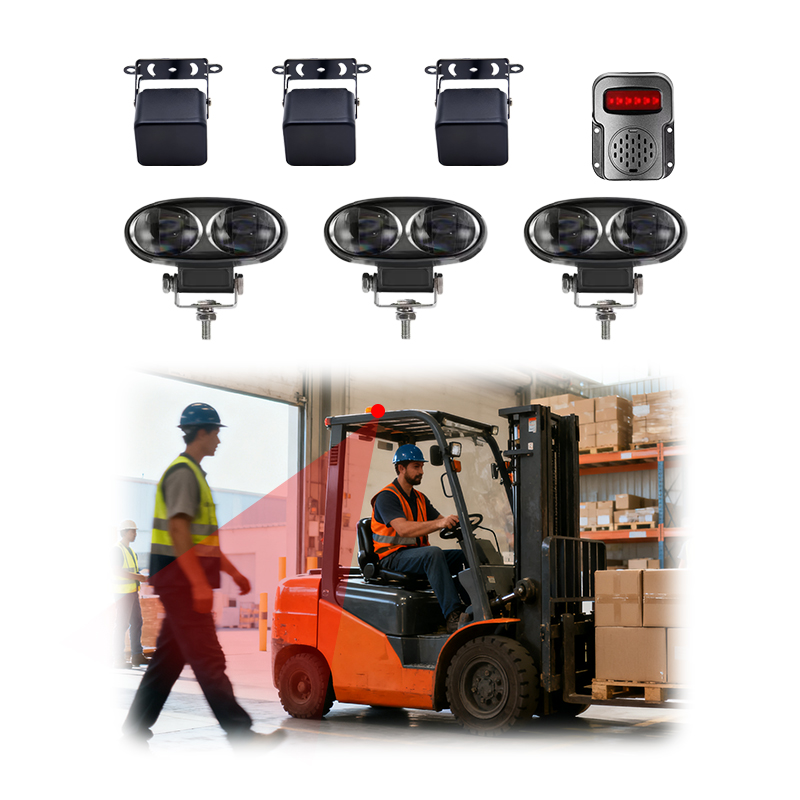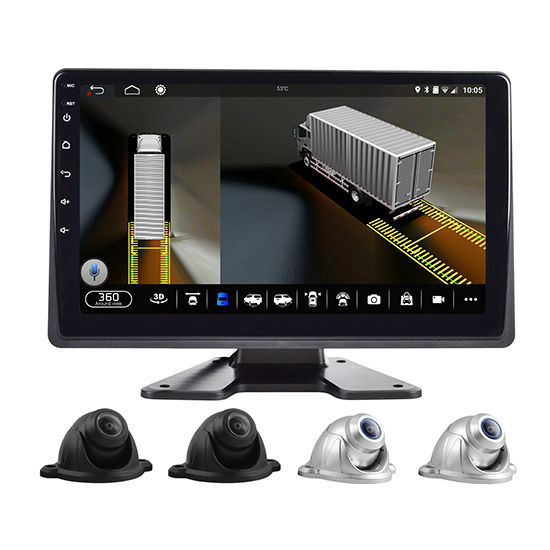
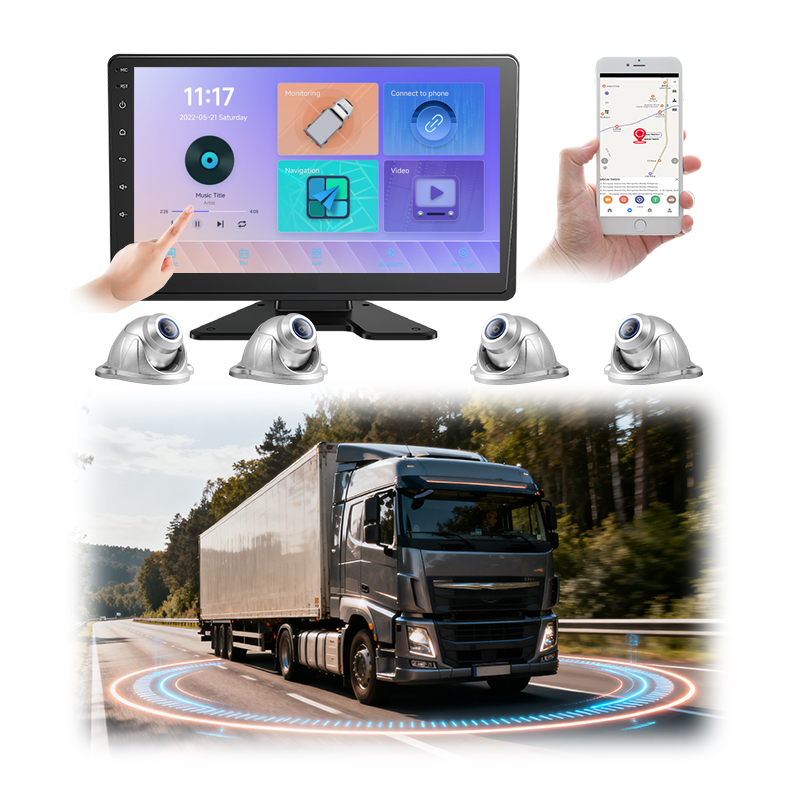
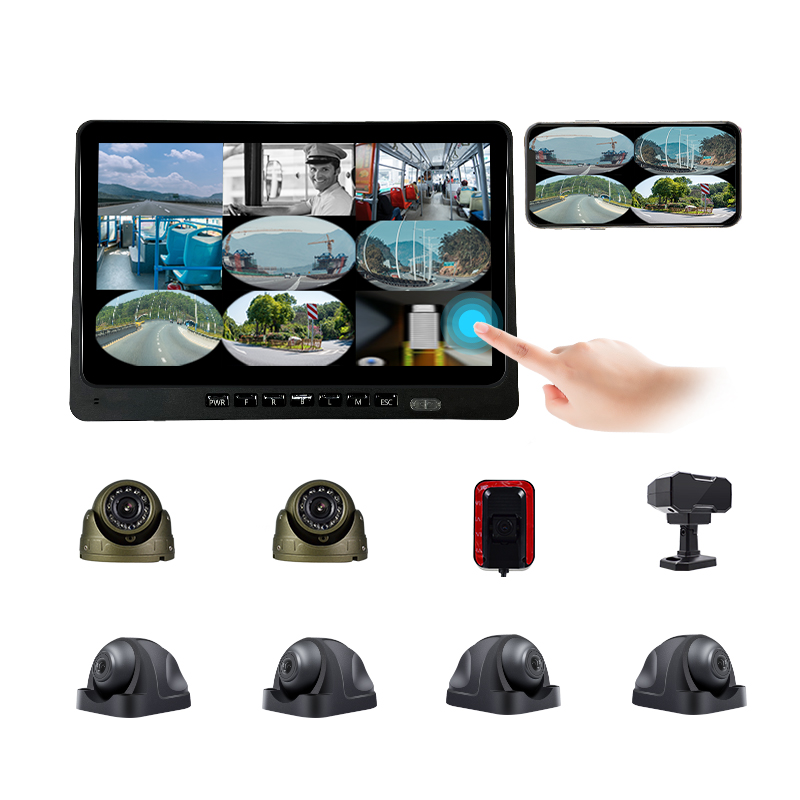
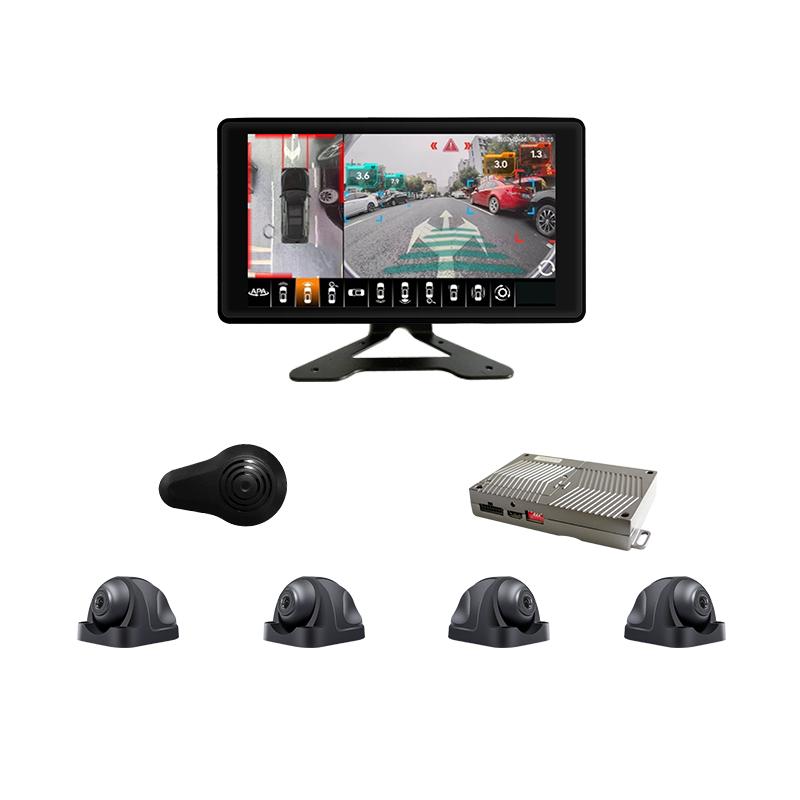
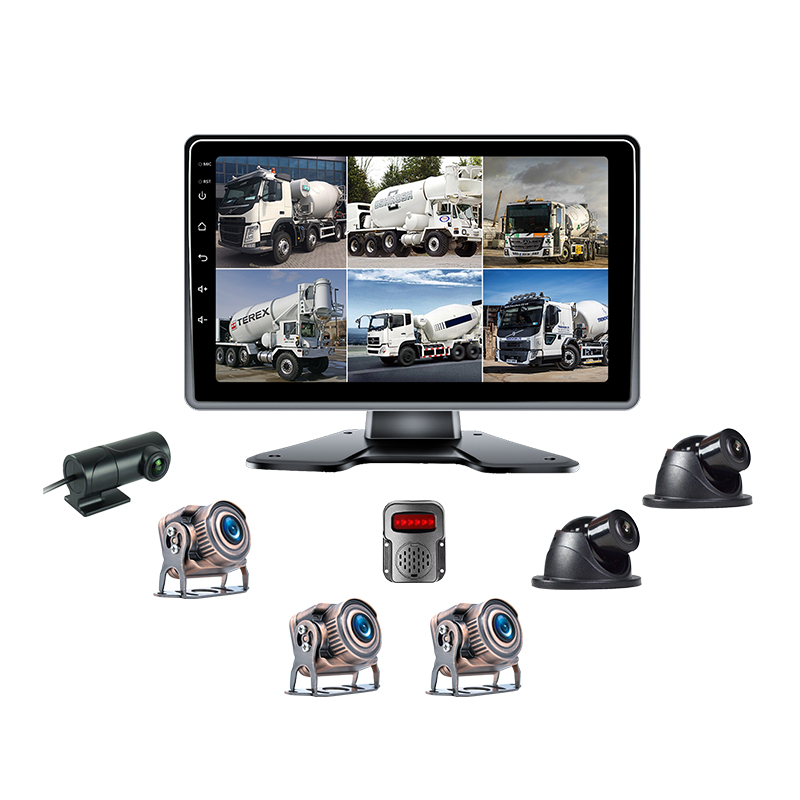
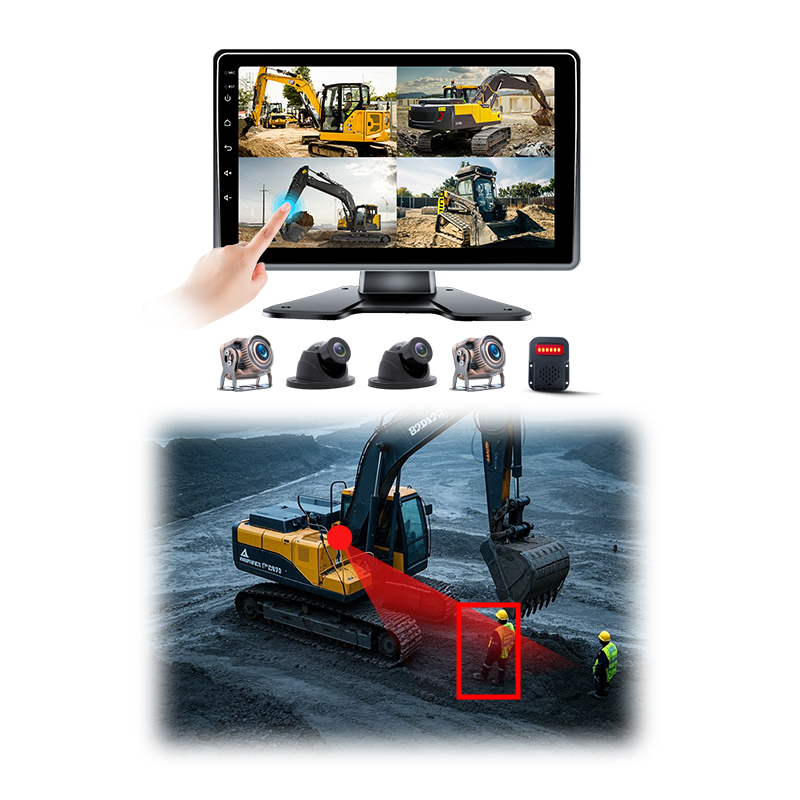
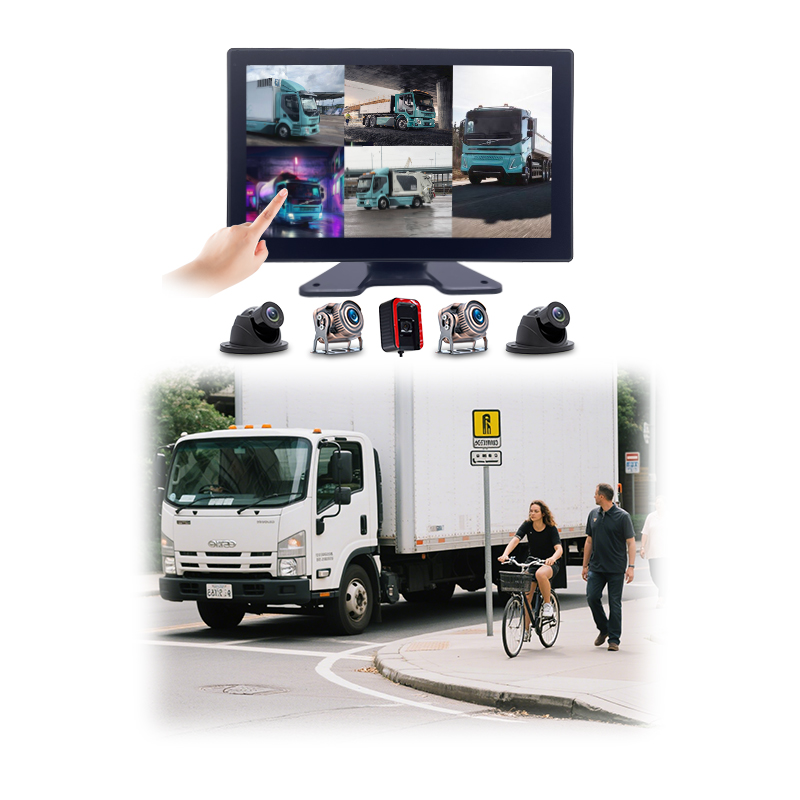
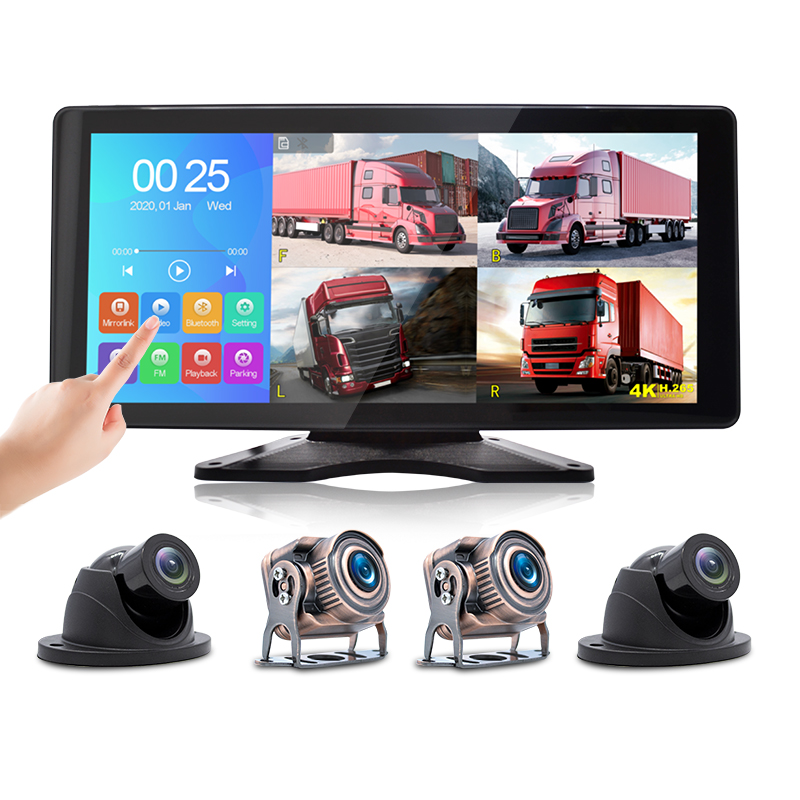
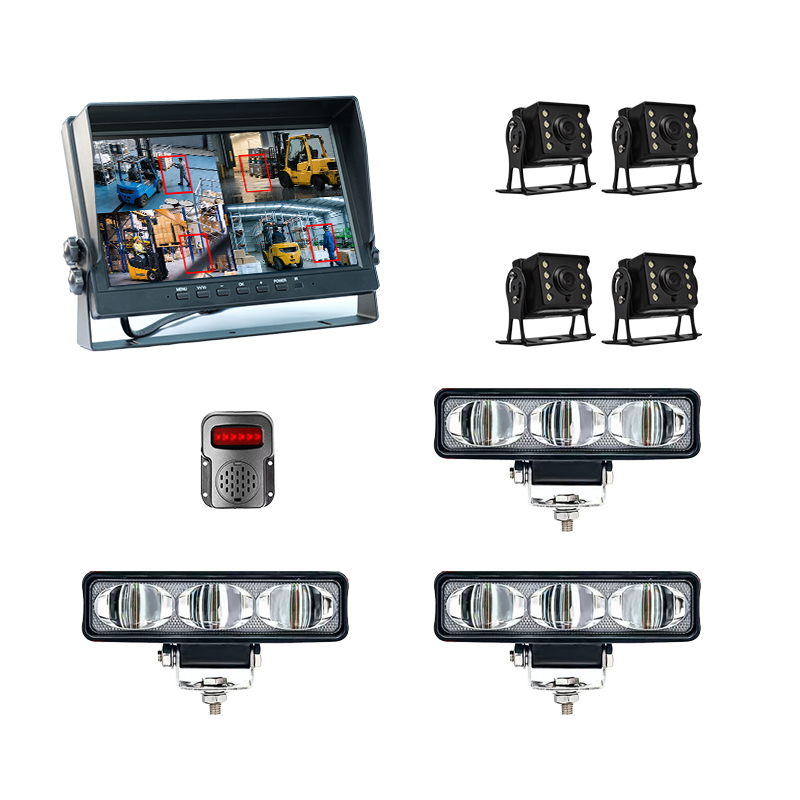
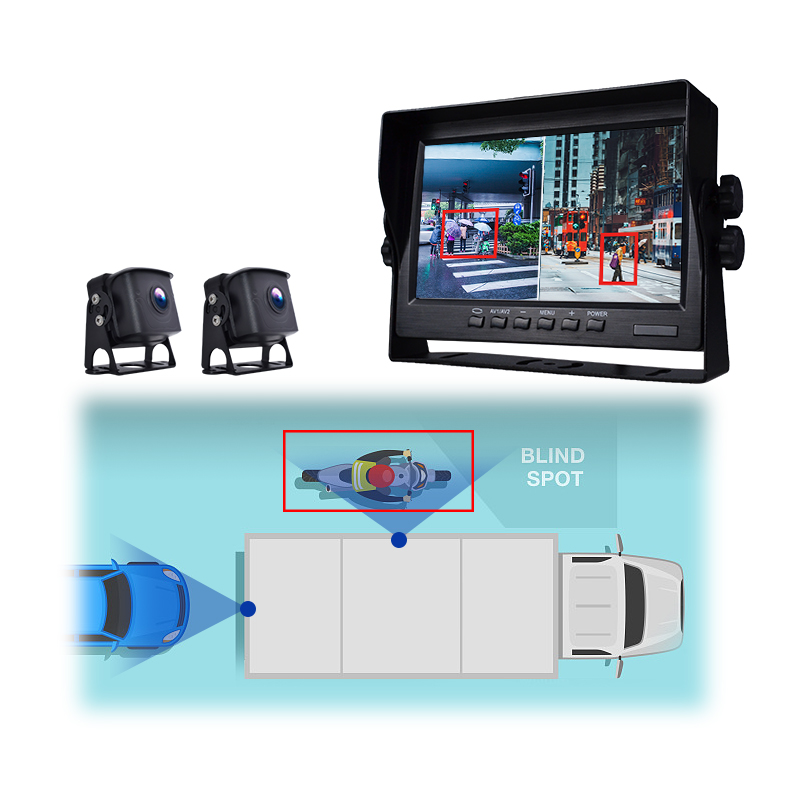
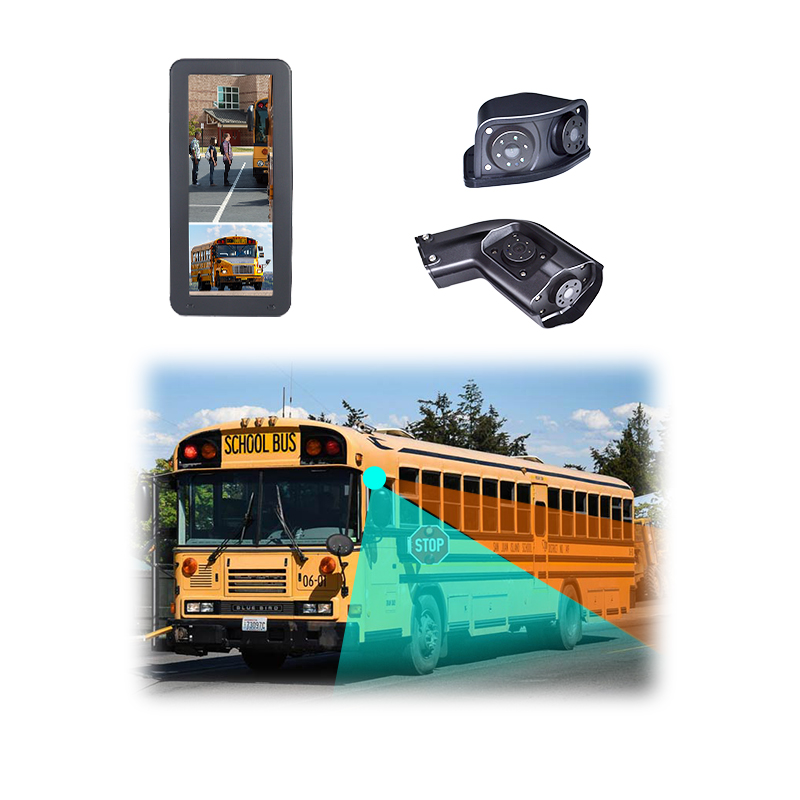
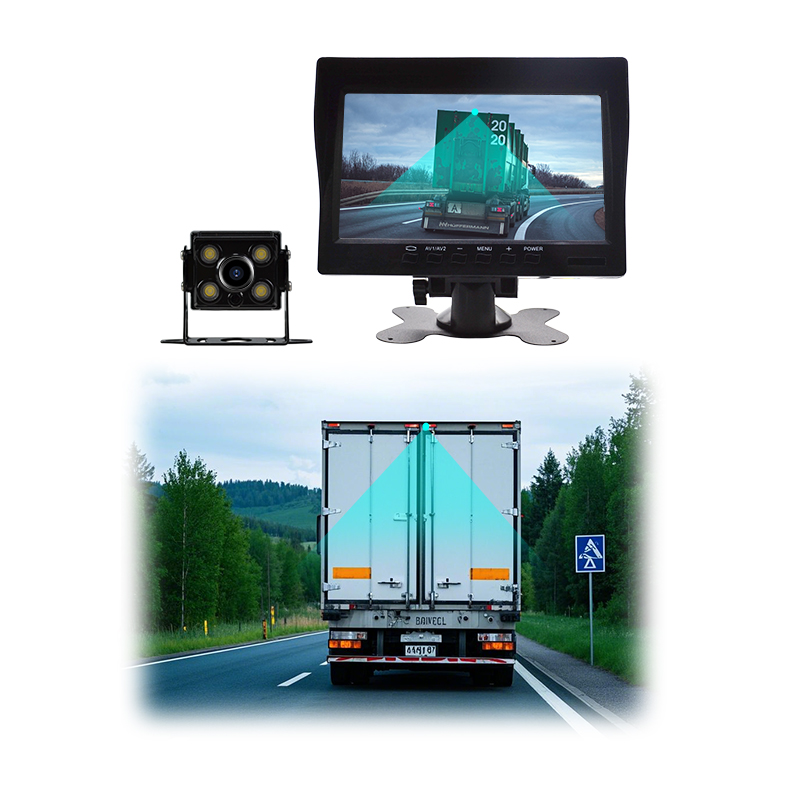
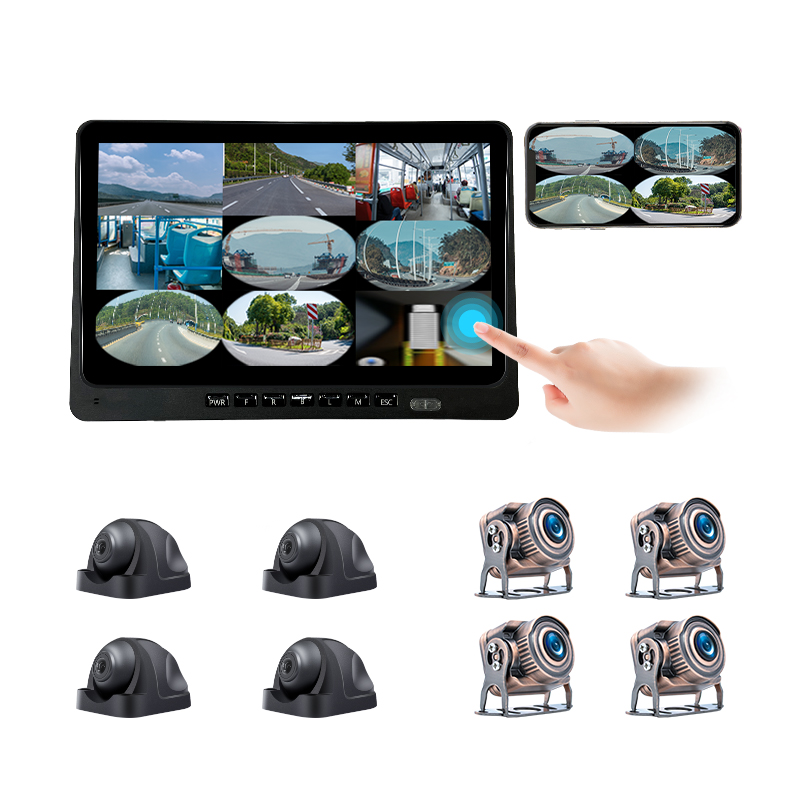
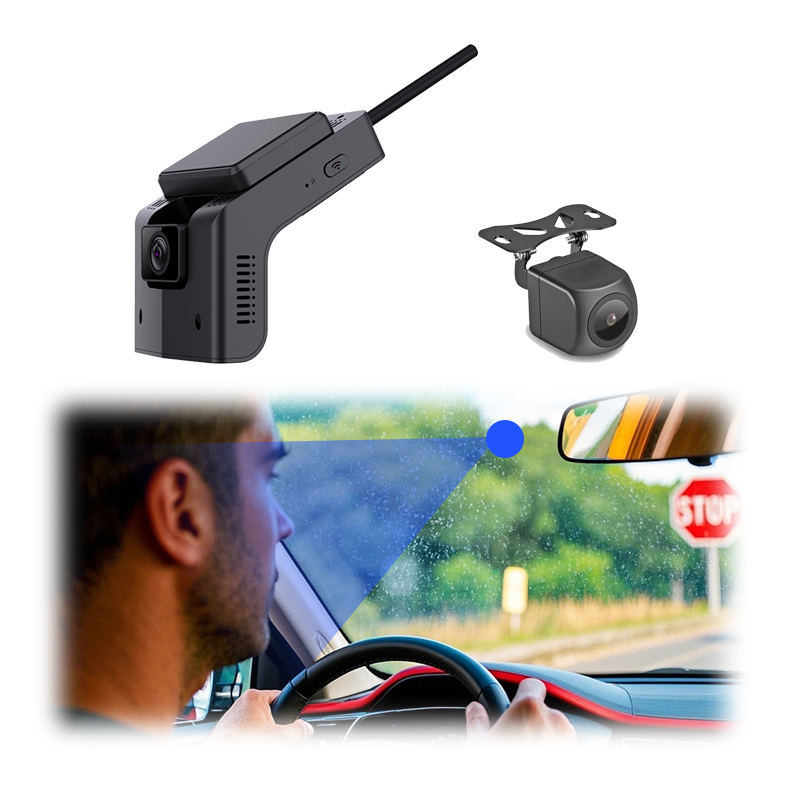
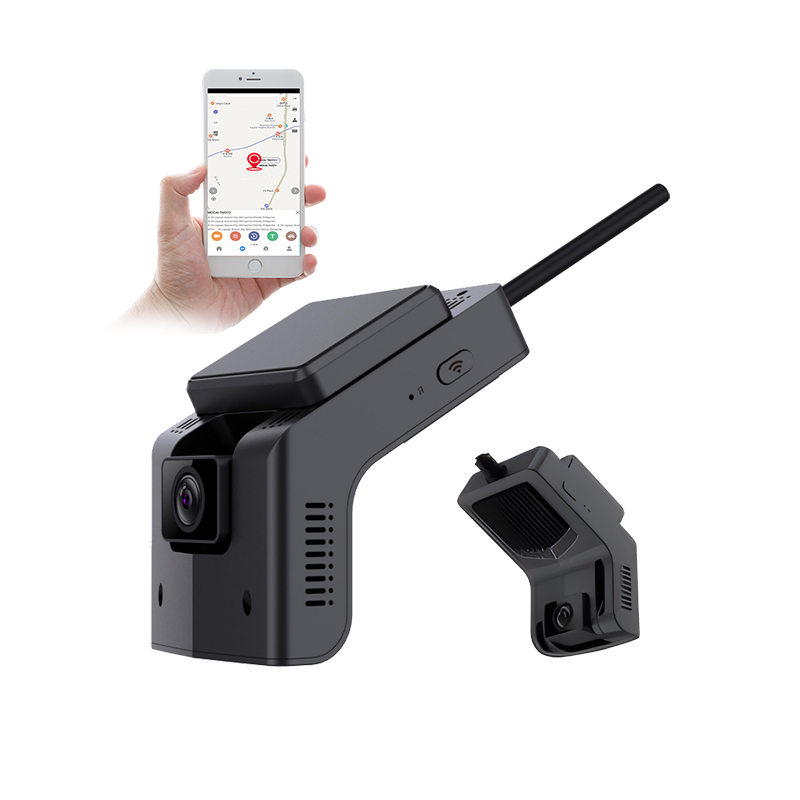
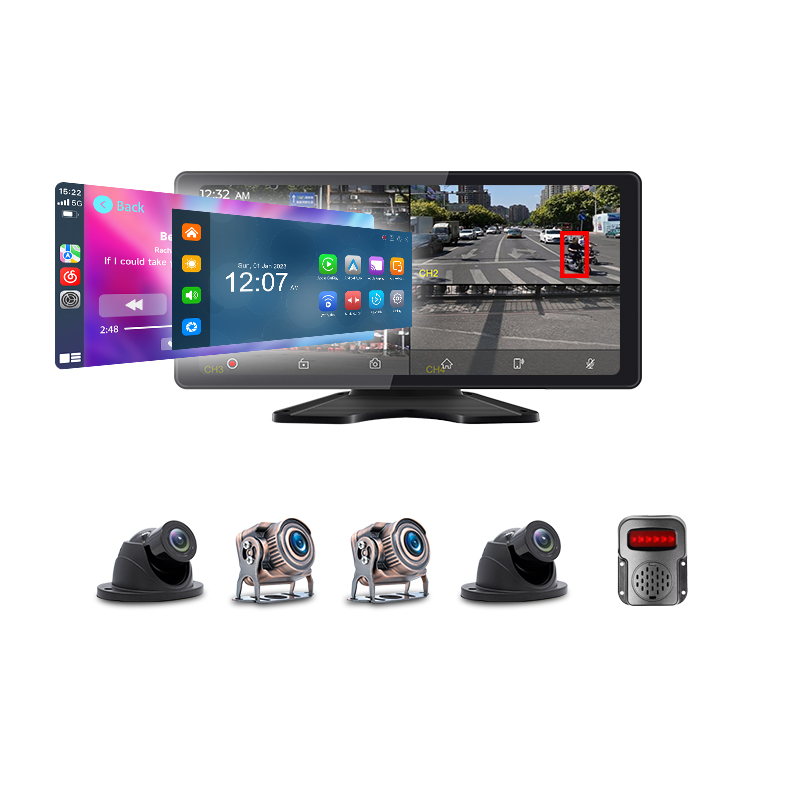
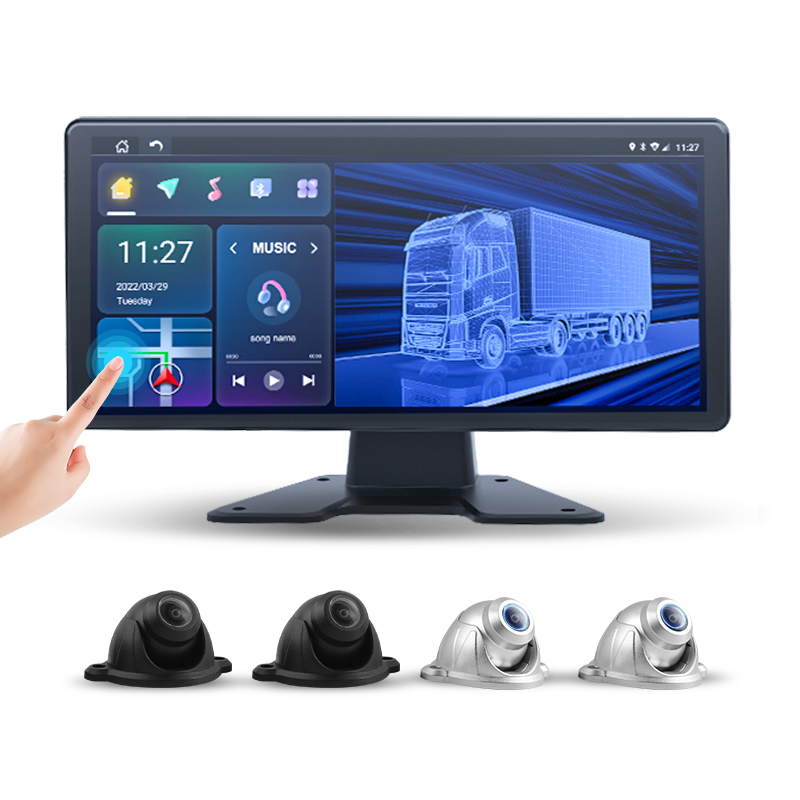
A surround view shows the driver where everything is. It cannot say whether an upright shape is a person or a pole. ADAS detects the person or the closing vehicle and calls a hazard, with no picture of where that hazard sits. The fused display puts the two together, the detection drawn onto the bird’s-eye view so the warning lands in the place it belongs. The hard part is deciding which warning to show, where to put it and how loud to make it, on one screen several systems all want at once.
The pillar has spent eleven pages on the bird’s-eye picture itself, how it is stitched, calibrated, kept true through weather and turns and articulation. The picture does not have the screen to itself. A modern commercial system shows the surround view with forward collision, lane departure, blind spot and driver monitoring all feeding the same display. On a commercial fitment the camera ring is joined by blind-spot radar down each side and a driver-facing monitor in the cab, three sensing systems whose outputs converge on one screen in front of one pair of eyes. The display has to make sense of them together.
The two halves answer different questions. The surround view answers where, a geometric map of the ground around the vehicle that the driver reads. ADAS answers what and how dangerous, a detector that finds an object and rates the threat. Neither half is enough alone. The picture still needs the driver to find the hazard in it. A bare alert gives a warning with no place attached. Fused, the warning lands on the map at the spot it refers to. Done wrong, the fusion cancels the safety it combines, a wall of alerts the driver tunes out or a warning lost under the picture it should have lit.
The bird’s-eye view becomes the canvas. Governing what gets painted on it is the work.
The surround view is a passive instrument. It takes the ground around the vehicle and lays it flat into one overhead map, true to scale, faithful about distance and position. What it does not do is judge. The flat-plane projection that builds the map reads height as smear. It cannot tell what an upright shape is, only show that something stands there. The view reports where a shape sits. Reading what the shape is and whether it matters is left to the driver. Because it only reports geometry, the view never raises a false alarm and never misses a real one. It makes no claim that could be wrong. It names nothing on the map, leaving every call to the person at the wheel.
An ADAS detector, a radar down the side or a model running on the camera feed, looks for objects and names them: a pedestrian, a cyclist, a vehicle closing from behind. It tracks them, rates how soon each becomes a problem and raises a warning when the threat crosses a line. The output is an alert, a chime, a light, a buzz in the seat. None of it is a map. ADAS knows there is a cyclist and how fast it is closing. It does not, on its own, show the driver the cyclist’s place in the scene. The detector holds its watch where the driver cannot. With the eyes on the mirror or the road ahead, the side radar covers the nearside, the quadrant no one is looking at.
On a commercial vehicle the detectors come as a set. Forward collision covers the road ahead. Lane departure tracks the markings. Blind-spot radar reaches down each side, where the mirrors and the nearside camera struggle. Rear cross-traffic guards the path behind as the vehicle backs. A driver-facing camera follows the driver’s own attention. Each is a separate detector with its own warning. Each warning calls for the driver the instant it fires.
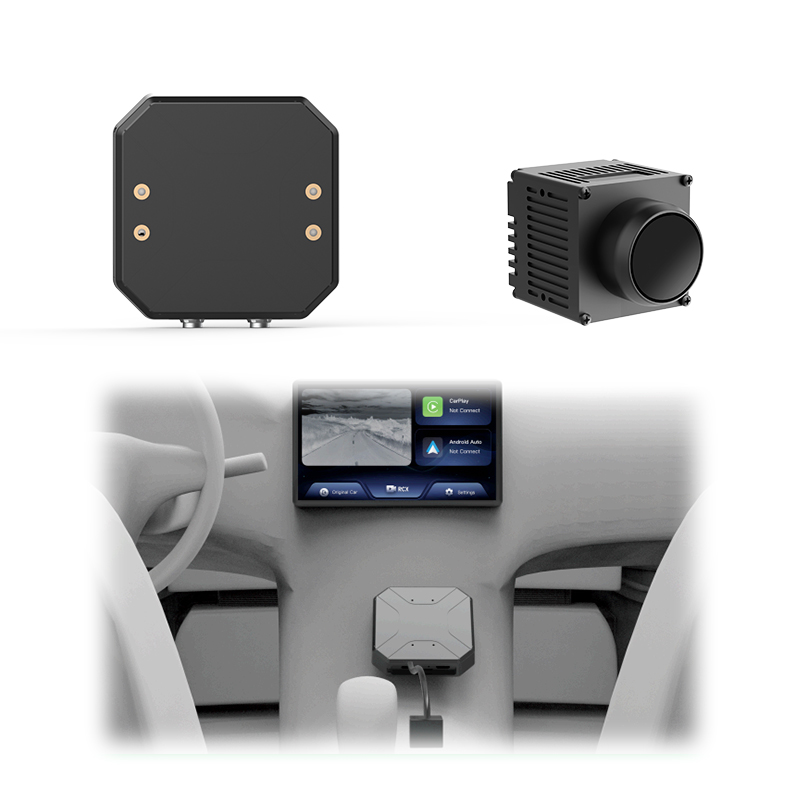
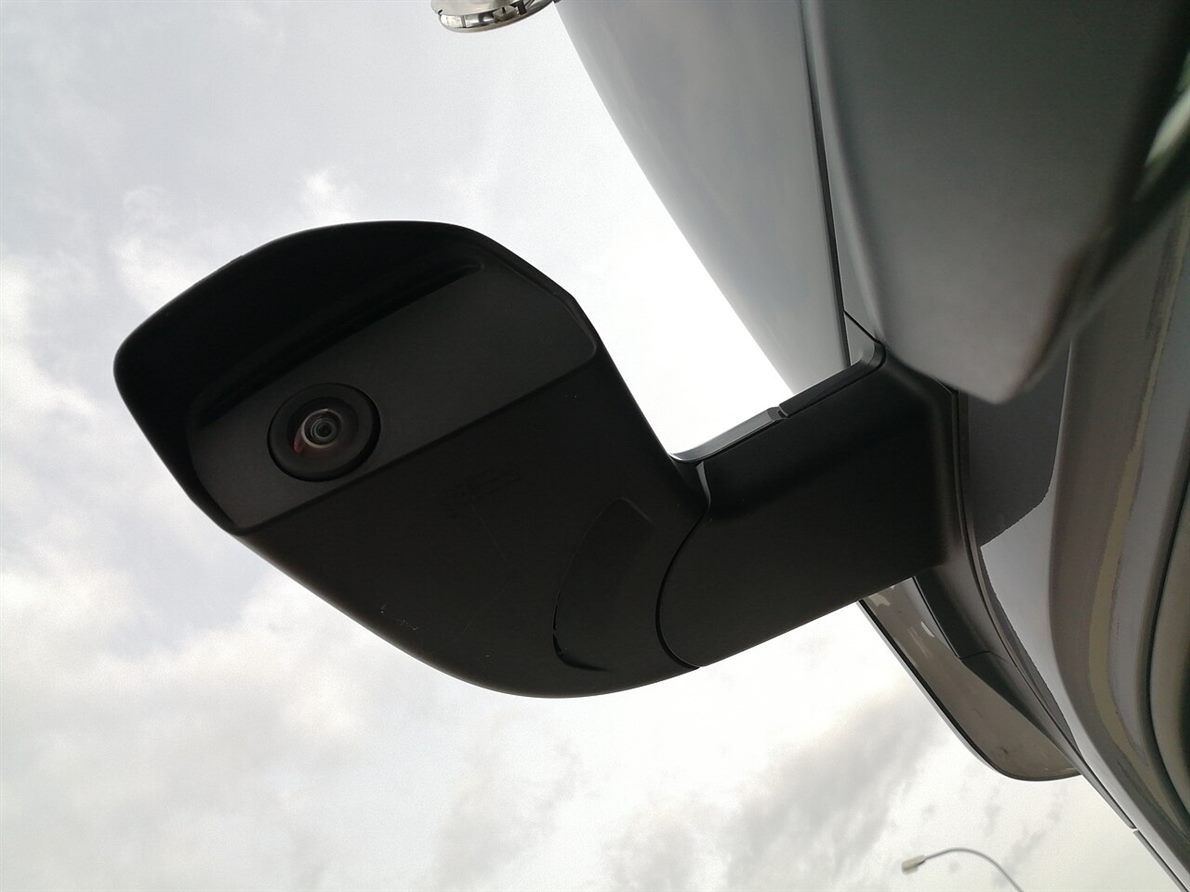
The two are not rivals for the same hardware. The cameras that build the surround view can feed the detectors too, the same pixels read once for geometry and once for objects. A camera on the mirror arm shows the nearside in the bowl and lets a model scan that nearside for a cyclist at the same time. The picture and the detection grow from one set of eyes. What stays separate is the job each does. The screen has to carry both and keep them apart.
Fusion’s first move is to put the detection on the map. A blind-spot radar reports a vehicle three meters off the left-rear corner. The bowl already has that corner, a known patch of ground at a known place. The system draws the warning there, a colored wedge over the left-rear of the bird’s-eye view, glowing where the vehicle is. The driver reads location and alert in one look, a lit quadrant exactly where the threat sits, no text to decode.
Drawing the marker in the right place is the catch. The detection arrives in its own terms, a radar bearing and range, or a box in a camera frame. The bowl is in ground coordinates. The two have to be tied together, the radar’s three-meters-left-rear mapped to the exact spot on the bowl that ground occupies. A wrong cross-calibration drifts the marker off the hazard, a glowing wedge a meter from the cyclist it means to flag. The fusion has its own alignment problem, between the detector and the view, on top of the alignment within the view the earlier pages solved.
Not every warning is a spot on the bowl. A vehicle in the blind spot has a place. It belongs on the map. Lane departure is about the whole vehicle’s path, a line it should not cross, with no single point beside the truck to mark. Forward collision is a thing ahead, often past the edge of the bowl. Driver monitoring is about the cab, with no ground to mark at all. These warnings get their own marks, an edge that flashes, an icon, a band along the relevant side, placed so the driver reads them without hunting. The fusion has to sort its warnings into those that live on the map and those that live around it.
Placed well, the fused marker turns a detection into a glance. The driver does not parse a row of warning lights and work out which side, which threat. The picture shows the threat in its place, sized and colored by how close it is. This is the whole point of fusing the two. One glance carries both the place and the meaning. The trouble starts when more than one detection fires at once. The screen has to choose.
With one screen and several systems that can all fire, the real engineering is arbitration, deciding which warning reaches the driver, in what place, at what strength. Three axes settle it. The first is priority, a ranking by how soon the threat bites. An imminent forward collision outranks a vehicle sitting in the blind spot, which outranks a slow drift toward a lane line. The top warning takes the loudest channel. The lesser ones drop to a quiet mark or wait. The second is space. Each warning is placed where its hazard is. Two that sit in different quadrants can show together without a fight, a forward bar and a left-rear wedge living on the same bowl at once. Only when two land in the same place, or both demand the loudest channel, does priority break the tie. The third is time. A warning holds steady once raised, smoothed by the same hysteresis the view uses, because an alert that strobes on and off reads as noise and gets ignored. Over these three runs an escalation ladder drawn from human-factors work. A low threat shows as a visual mark alone, a rising one adds a directional chime, an urgent one adds a haptic pulse in the seat or the wheel, the modalities stacking as the danger climbs. Research on driver warnings is consistent that the visual-auditory-haptic combination reaches a driver more reliably than any single channel. Visual alone performs worst. The ladder exists for that reason. A single flashing light is the weakest form. The direction carries information too, a chime from the left, a buzz on the left of the seat, pointing the driver at the side the threat is on before the eyes even reach the screen. The driver-monitoring channel does more than raise its own alarm. It tunes the others, lifting the escalation a step when the driver’s gaze has been off the road, easing it when attention returns. The same blind-spot event then shouts louder at a distracted driver than at an alert one. The danger in all of this is a bad ranking. A flooded screen fires every channel at once. The driver learns to tune the whole system out. A wrong suppression holds back the warning that mattered. Either way the fusion has failed at the one job that separates it from a row of idiot lights, putting the right hazard in front of the driver at the right strength at the right moment. The arbitration is the part of a fused display that decides whether a warning helps or just adds to the noise. A buyer should press on how it ranks before how the graphics look.
A warning drawn on the picture can hide the thing it warns about. Put a solid red box over the cyclist in the bowl and the driver sees a red box where the cyclist was. The alert arrives and the hazard disappears under it, the worst outcome a fused display can produce, a warning that erases its own subject.
The rule is that the marker frames the hazard and leaves it visible. An outline around the figure, a bracket at its corners, a colored wedge on the ground beneath it, an arrow pointing in from the edge: every one of these draws the eye to the object and keeps the object in view. The pixels showing the cyclist stay on screen. The marker adds to those pixels. It does not paint them out. A driver has to see what the system saw, the object itself. Between the bare outline and the solid box sits a light tint, a wash of color over the hazard’s footprint that marks it while keeping it in view. A mark that pulses pulls the eye faster than one that sits still, the same draw to motion that makes a wandering seam dangerous, put here to good use on the thing that matters.
The marker has to stand clear of the picture under it. The bowl is full of its own color, road, paint, other vehicles. The warning needs a look reserved for warnings, a saturated edge or a pulse the scene never shows on its own. It has to be sized to the threat, growing and reddening as the hazard closes, kept small enough that it never blankets the quadrant it sits in. A marker that floods half the bowl trades one kind of blindness for another. Color carries meaning when it holds steady, amber for a presence the driver should note, red for a threat that needs action, the same code every time, read at a glance. The mark has to keep its contrast against a bright noon bowl and a dark wet one alike, the conditions the weather page laid out.
The marker has to be as honest as the view. A detection the system is unsure of should wear a softer mark, a faint outline kept apart from the hard box of a confirmed object, because a confident marker over an empty patch teaches the driver to doubt all of them. A hazard the bowl does not cover, a vehicle still beyond the bird’s-eye edge, gets an arrow at the rim pointing out to it, with no fabricated shape placed inside the bowl where the ground was never seen. The marker tells the truth about what is known and where, or it joins the noise.
The balance between the two halves is not fixed. What the driver needs from the screen changes with the speed and the task. A good display follows that, leaning on the bowl at one moment and on the warnings at another. Each task calls up a layout that fits it, a docking view heavy on the rear and sides, a road view stripped to the forward warnings, a small set the speed and gear select between.
At low speed the bowl leads. In a yard, at a dock, threading a gate, the driver is placing a large vehicle in tight space. At a crawl a glance down at the screen costs little, the vehicle slow enough to give the driver that look. The geometric map is the thing that matters. The overhead fills the screen. ADAS rides on top of it, a rear cross-traffic mark, a pedestrian wedge, drawn into the bowl where it belongs. The detection serves the picture here, pointing at hazards within the scene the driver is already reading.
At road speed the balance tips. A bird’s-eye view of the ground beside a truck doing eighty has little to say. Nobody parks at speed. The driver’s eyes belong on the road now. A warning has to land in a glance or a sound. No detailed picture should pull the gaze down into the cab. Forward collision and lane departure are what matter now, threats out ahead and at the lane edges, past what the bowl covers. The display gives them the room, the overhead shrinking to a corner or stepping aside, the warnings that fit highway speed taking the front.
Gear and speed drive the change, the same triggers that pick a segment on a long combination. Reverse brings up the rear of the bowl with the cross-traffic detection laid over it. Crossing from yard speed to the road shifts the weight forward. The switch has to be smooth and predictable, held by the same hysteresis that keeps a view from strobing, because a display that lurches between layouts is as hard to read as one that strobes a single mark.
On a clear road at a steady speed, neither half needs to shout. The best fused display knows when to go quiet, holding a calm screen so that when something does fire, the driver still has the attention to spend on it.
A warning the driver stops believing is worse than no warning. Too many alerts, too often, teach the brain to filter them out, the chime becoming background, the flashing edge becoming wallpaper. When the one that matters finally fires, it lands in the same ignored channel as the hundred that did not. A fused display can fail without missing a single hazard, by warning so freely that its warnings stop being heard. Drivers do more than ignore a nagging system. They switch it off. A blind-spot warning that fires on every passing car gets muted by the first week. A muted system protects no one. The fatigue is how a safety feature ends up disconnected.
The cure is to warn less. A blind-spot detector on a busy road sees a vehicle alongside almost always. A system that alarmed on each one would never stop. The fix is context. The blind-spot warning rises only when the driver signals or drifts toward the occupied side, the moment the vehicle there becomes a reason to act. The same detection that is noise going straight is a real alert mid-lane-change. Intent, read from the indicator and the wheel, decides which it is. Warning has more settings than on and off. A quiet, always-on mark can show that something is there, the loud alert held back for the moment action is needed. The driver keeps the awareness and is spared the alarm until it counts.
Suppression has its own danger. Too much suppression leaves a real hazard unannounced, the fatigue cure turned into a blindness of its own. The driver-facing camera complicates the balance. An inattentive driver should get more warning and an attentive one less, the system reading the driver to set the level. The trap is warning a tired driver so often that the warnings become the wallpaper they were meant to cut through. The line sits at action. A warning is justified only when the driver would do something about what it shows. How well a system holds that line is a fair thing to ask a vendor, because the false-alarm rate shapes whether the driver trusts the screen at all. A fused display is judged as much by the warnings it withholds as by the ones it raises.
A fused display carries a quiet danger. Once detection markers appear on the bowl, the driver starts to trust the bowl to detect. A clean screen, no wedge, no box, reads as all clear. The bowl renders geometry and detects nothing. A pedestrian the detector missed, or one standing in a gap the detector does not cover, appears on the bowl as ordinary ground, unmarked and unremarkable. The gaps are real and specific. A small child can sit below a radar’s lowest beam. A figure in dark clothing can fall below what the night camera’s detector pulls out. A pedestrian behind a pillar is hidden from the sensor meant to find them.
The display has to hold the line between seen and detected. Every pixel of the bowl is seen, a faithful image of the ground. Only the marked objects are detected, picked out and vouched for by a system with limits. The absence of a marker means the detector found nothing there. It does not mean nothing is there. Those are two different claims. A driver who reads the second when the system made only the first is trusting more than the screen can promise.
The fix is to promise only what is true. A fused display should mark what it detects and leave the rest of the bowl honest, showing clear ground as clear ground with no promise attached. The detector has range it cannot exceed, angles it cannot see, objects it cannot classify. The honest display leaves those gaps looking like gaps. When the detection runs on the camera feed, a fouled lens blinds it as surely as it blinds the view. The marker vanishes because the detector went dark. The hazard it should have caught is still in the scene. A degraded detector should announce that it has gone blind, a silent stop looking exactly like a clear road. The bird’s-eye view stays a view to be read, the detection a detector with its limits. The fusion works when it sharpens both and blurs neither.
A handful of questions put a fused display on an order sheet. The first is placement, whether a warning lands on the bowl at the hazard’s spot or only as a light off to the side. The second is arbitration, how the system ranks several alerts at once and lets them share the screen. The third is the marker, whether it frames the hazard or paints over it, with the alert climbing from visual to audible to haptic as the threat grows. The fourth is restraint, how the system holds down false alarms and shifts weight from bowl to warnings as the speed rises.
Two checks tell the story. A real hazard set in a blind spot shows whether the marker lands on it and rings it while keeping it in view. A road full of passing traffic shows whether the system can stay quiet. A display that places the danger and stays silent the rest of the time has done its job. This is the point where the surround view turns from a picture of the ground into part of how the vehicle keeps people safe.
It means drawing the detection onto the picture. The surround view is a geometric map of the ground around the vehicle. ADAS detects objects and rates threats, with no map of its own. Fusion places each detection on the bowl at the spot it occupies, a colored wedge over the blind-spot vehicle, a marker on the pedestrian. The driver reads the warning where the hazard is, no separate light to decode. Location and meaning arrive together, in one place.
Because the view cannot judge and the driver cannot watch everywhere. The bird’s-eye picture is faithful about where things are. What they are, it cannot say. Its flat-plane projection cannot separate a person from a pole. The driver could read it, given the attention. At a busy junction the eyes are on the mirror, the road and the gauges, away from the one quadrant where a cyclist sits. ADAS watches that quadrant and names the cyclist. Together they cover what neither does alone, the scene and the thing in it the driver has no spare glance for.
It arbitrates on three axes. Priority ranks them by how soon the threat bites, an imminent collision ahead of a blind-spot presence ahead of a slow lane drift. Space places each where its hazard is. Two in different quadrants can show together. Time holds each warning steady, smoothed so it does not strobe. Over these runs an escalation ladder, a visual mark for a low threat, a directional chime as it rises, a haptic pulse for the urgent case, since the visual-auditory-haptic combination reaches a driver more reliably than any single channel. The top threat takes the loudest channel. The rest wait or stay quiet.
It can. A careless one does. A solid box dropped over a cyclist in the bowl shows the driver a box where the cyclist was, the alert erasing its own subject. The rule is to frame the hazard, leaving it in view: an outline, a bracket, a wedge on the ground beneath, an arrow from the edge, each drawing the eye to the object. The marker stands out from the bowl’s own colors and sizes itself to the threat, kept small enough that it never blankets the quadrant. A good marker adds to the picture and takes nothing away from it.
Because a warning the driver stops believing is worse than none. A blind-spot alert that fires on every passing car on a busy road becomes background, muted within a week. A muted system protects no one. The cure is context: the warning rises only when the driver signals or drifts toward the occupied side, the moment the vehicle there matters. A quiet, always-on mark can show that something is present, with the loud alert saved for when action is needed. The value of a fused display is as much in the alarms it withholds as in the ones it raises.
No. The bowl renders geometry and does not detect. A clean screen means the detector marked nothing, a weaker thing than nothing being there. A pedestrian the radar missed, a child below its beam, a figure the night camera could not pull out, all appear on the bowl as ordinary ground. If the cameras are fouled, the detection running on them goes blind too. The markers vanish. The hazards stay in the scene. The fused display aids the driver’s own eyes. It does not replace the mirror check or the look over the shoulder.