







Commercial vehicle AEB is built around the weight of a truck from the start. It has the same goal as passenger car AEB, stopping the vehicle before it hits what is ahead. The way it reaches that goal is its own. A forty-tonne truck and a one-and-a-half-tonne car bring different physics to the same emergency: the mass, the stopping distance, the brakes, the cost of getting it wrong are each in another league. An AEB built for the car and scaled up would brake too late on the truck. The commercial system has to be designed around the weight from the start.
The gap starts with weight and runs through everything. A loaded truck carries more than twenty times the mass of a car. At the same speed it carries more than twenty times the energy. It needs far more room to shed it. Its brakes run on compressed air where a car’s run on fluid. They answer a beat later. Its load can double or halve between trips. Behind the cab it may tow one or two trailers that can swing out of line under a hard stop. Each of these bends the AEB problem away from the passenger-car version.
None of this is exotic. It is the daily condition of a working truck. It is why the warning logic covered elsewhere, the forward collision warning that decides when a crash is coming, hands off to a braking response built to the truck’s own rules. The warning is common to both. How hard and how early the truck brakes on that warning is built to its own rules.
The stakes ride on getting it right. A truck that fails to stop in time does not merely dent a bumper. Its mass turns a rear-end collision into a far deadlier event than the same crash between cars, the damage measured in lives. Rear-end crashes are common for trucks and highly avoidable, the reason regulators reached for AEB on heavy vehicles early. Regulation can require the system; building one that works around the truck’s own physics is the engineering problem underneath.
A truck has its own physics. Its emergency braking has to be designed around the truck from the start.
Automatic emergency braking is the step past the warning. A forward collision system watches the road ahead and judges when a crash is coming. Its first move is to warn the driver. When the warning goes unheeded and the gap keeps closing, AEB acts on its own, braking the vehicle to avoid the crash or to take speed out of it. The chain runs in stages, a warning first, partial braking next, full braking last if nothing changes.
Deciding when to act is the warning system’s job, taken up where forward collision warning is covered. It turns on time to collision, the seconds left before impact at the present closing rate. That judgment is much the same whether the vehicle is a car or a truck. What happens once the system decides to brake is built entirely to the truck’s weight.
The decision to brake hard is not taken lightly. A false stop, braking for a threat that is not there, is dangerous on any vehicle, the more so on a heavy one the traffic behind cannot easily avoid. The system holds off for confirmation, a target held across several readings, a closing rate that does not relent. The bar for braking sits high, the work of tuning it taken up where false alarm rates are covered. Once that bar is met, the truck and the car part company.
The shared part ends quickly. Both vehicles watch, warn, confirm, brake, in that order. From the moment the brakes come on, the truck’s mass, its air system, its load and its trailers all shape the response. That response is built to a different set of rules.
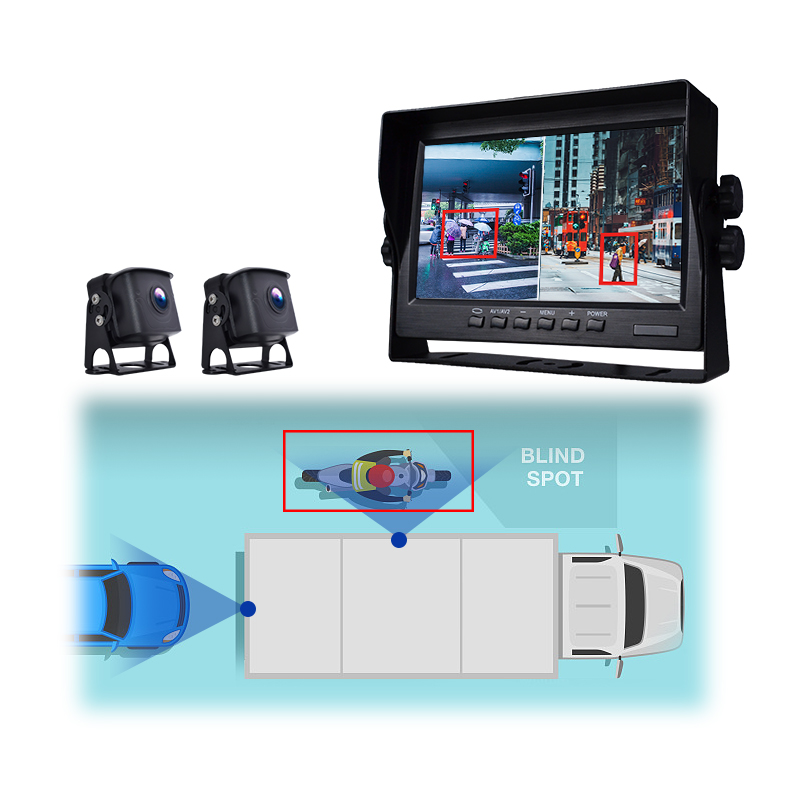
Even the eyes sit in a different place. A truck mounts its radar and camera high, on a cab two or three meters up, looking down at the road. The high view reaches far down the lane, useful for the long ranges a truck must watch. It opens a deep blind spot close to the bumper too, where a small car or a pedestrian can sit below the beam. The truck’s field of view, near and far, is shaped by that high mount before the braking logic even begins.
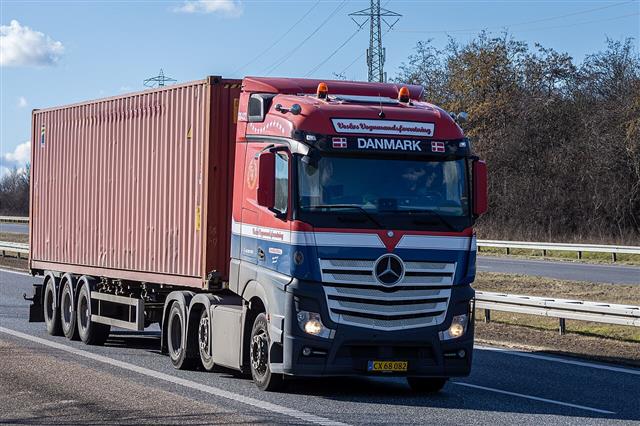
The first and largest difference is mass. Everything an emergency stop has to overcome scales with it. A passenger car masses something over a tonne. A loaded articulated truck can reach forty tonnes, more than twenty times as much. That ratio is the root from which the rest of the differences grow.
Kinetic energy rises with mass and with the square of speed, half the mass times the speed squared. Twenty times the mass is twenty times the energy at the same speed, energy the brakes have to turn into heat before the vehicle stops. The brakes are sized up to match. The physics stays unforgiving: more energy takes more distance to dissipate. A truck needs a longer stretch of road to stop from a given speed than a car does, often markedly longer.
A longer stopping distance changes when the braking has to begin. If a truck takes half again as far to stop, its AEB has to start braking earlier to cover the same gap, at a longer time to collision than a car’s would use. The system cannot wait for the last instant, because for the truck that instant has already passed. Reading the threat early matters more on the vehicle that takes longer to answer it.
The numbers are sobering. From highway speed a fully loaded truck can need the better part of a hundred meters to stop. The heavier the load and the higher the speed, the wider the gap. An AEB that began braking a moment late can still arrive too late for a forty-tonne load. That is why a truck’s AEB is tuned for the loaded case, the setting that holds up when the vehicle is full.
Braking earlier asks more of the decision. The further ahead a system must commit, the longer the range at which it has to be sure a crash is real, on thinner evidence than a last-instant stop would have. The truck’s AEB lives with a harder version of the trade-off every AEB faces, between acting early enough to matter and waiting long enough to be right. Mass sets the terms of that trade before the software makes a single choice.
Heat is the other side of mass. All that energy turns into heat in the brakes. On a long descent a loaded truck can pour it in faster than the brakes shed it, until they fade and give less for the same pressure. A forty-tonne truck on a mountain grade meets it daily, the reason it leans on engine and retarder braking to save the wheel brakes. An AEB has to reckon with brakes whose strength is not fixed, that may already be hot and weakened when the emergency comes. The braking it can count on is a moving figure.
A car carries a small fraction of its own weight in load. Five people and their bags might add a quarter to its mass, no more. A truck is built to carry. What it hauls can outweigh the empty truck itself. An empty rig and the same rig fully loaded are, to the brakes, two different vehicles, one perhaps three times the mass of the other.
That range breaks any single setting. An AEB tuned for the empty truck assumes brakes that stop a light vehicle quickly. It waits accordingly. It then finds the loaded truck needs far more room than it left. An AEB tuned for the full load brakes early and hard for a mass that is not there when the truck runs empty, stopping short and nagging the driver with stops that were never needed. One fixed deceleration cannot serve a vehicle whose mass swings by a factor of three.
The way out is to measure the load. A commercial AEB does better when it knows the mass it is working with, estimating it from how the vehicle accelerates, how the engine and driveline behave, or from axle-load sensors on air suspension. With a live estimate of mass, the system sets its braking to the truck as loaded today, early and firm when heavy, easier when light. The estimate is never perfect. It still beats a fixed guess by a wide margin.
Estimating the mass is its own problem. The system reads weight from how the truck responds, a reading that takes a stretch of driving to settle. A truck that has just loaded may run for a time on an old figure. A mid-route pickup or drop changes the mass between stops. The safe response to doubt is to assume the heavier case, braking earlier than a lighter truck would need, accepting a few early stops as the price of not arriving late on a full load. Even an imperfect weight beats none. A system blind to load has no way to make that call at all.
A car needs none of this. Its load barely moves the figures, so one calibration covers it from empty to full. Tracking a changing weight falls to the commercial system alone.
The brakes themselves work on a different medium. Almost every heavy truck stops with air brakes, where the pedal meters compressed air to a chamber at each wheel that pushes the shoe onto the drum or pad. A car uses hydraulics, where the pedal pushes brake fluid through sealed lines straight to each wheel. The choice is sound for a heavy vehicle: air brakes are powerful and fail safe, holding the truck when pressure is lost. They draw on air stored in tanks, split across independent circuits so one burst line cannot empty them all. The medium carries a cost in time.
Air compresses. When it is metered into a long brake line, it has to flow and build pressure along the way before the chambers act. That takes time. The lag between command and braking on a big air-braked truck runs around half a second.
Half a second sounds small until speed is put to it. At motorway speed a truck covers fifteen meters or more in that half second, rolling at full speed as the air builds, before a single brake has bitten. For an AEB counting on a stopping distance, that lag is dead distance added to the front of every stop. The system has to account for it, issuing its brake command earlier to leave room for the brakes to answer.
Good commercial systems plan around the delay. They can pre-charge the brakes when a threat first appears, taking up the slack in the lines and leaving the air ready to act the instant a stop is called. They model the lag in deciding when to command the stop. The aim is to hide the half second from the outcome, to make an air-braked truck stop as if its brakes answered at once. The delay never fully disappears. It becomes one more quantity the commercial AEB has to carry.
Electronics are closing some of the gap. The modern heavy truck brakes through an electronic braking system, an EBS, that carries the brake command down a wire as the air does the muscle work. The signal reaches the wheels ahead of the air pressure. The system can meter each wheel precisely, the foundation an AEB needs to brake hard and straight. EBS trims the old air lag without erasing it. The wire is quick. The air it controls still has to build. A commercial AEB is built on top of EBS.
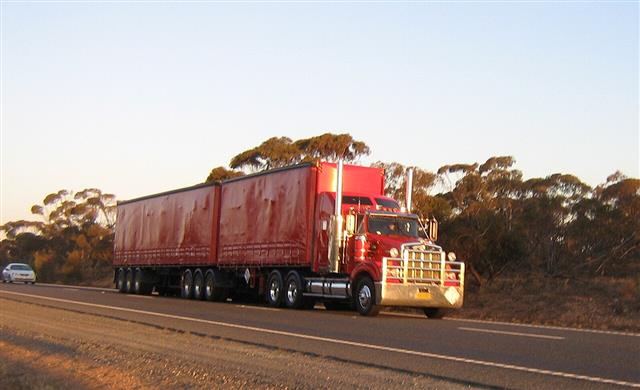
A truck with a trailer is two bodies, joined at a pivot. Much of the mass often sits in the trailer. The trailer has brakes and momentum of its own. When the tractor brakes hard, the loaded trailer behind keeps pushing forward, bearing down on the coupling. Stopping the combination means keeping two bodies in line as both try to stop at once.
Push the brakes too hard and the trailer can break the line. If the trailer’s wheels lock before the tractor’s, the trailer loses its grip on the road and begins to slide, swinging out to one side. The rig folds at the coupling, the jackknife that every truck driver is trained to fear. A hard automatic stop, called by a machine, can set off the same fold if it ignores what the trailer is doing.
This puts a ceiling on how hard AEB can brake. The system cannot command maximum braking outright, because maximum braking is what folds the rig. It has to work with the anti-lock brakes and the trailer’s own brakes, metering pressure to each set of wheels to hold everything straight, easing off where a wheel starts to lock. On a modern rig the trailer brakes electronically as well, the tractor timing its braking to the trailer’s to pull the combination up as one. That metering costs braking force, which lengthens the stop. The commercial AEB brakes as hard as it can without losing the trailer.
A second trailer, as a B-double carries, deepens the problem, adding pivots and masses and fresh ways for the combination to step out of line under a heavy stop. The trailer is a constraint the passenger system was never built to handle.
The split runs deep enough that the law itself treats the two apart. The rules that make AEB mandatory and the tests a system must pass are written separately for heavy vehicles and for cars. A commercial AEB is built to clear the heavy-vehicle bar. The two sets of rules were drawn up by different working groups, to different test protocols, with the weight gap in plain view.
In the international framework, advanced emergency braking for heavy vehicles is governed by UN Regulation 131. It applies to the larger categories, buses and coaches and the heavier goods vehicles, the classes a road authority labels M2, M3, N2 and N3. Under it an AEBS must detect a forward collision, warn the driver, brake automatically if no one acts, tested against a stopped or slower vehicle ahead. In the European Union the regulation is phased in for new vehicle types from 2025 and for all new registrations of those categories from 2028.
Passenger cars answer to a separate track. A different regulation and the consumer crash-test programs set the AEB expectations for cars and the lightest vans, with their own test speeds, targets and pass marks geared to a light vehicle. The point is that the safety world long ago concluded a truck’s AEB and a car’s are different enough to regulate apart. The physics of weight and air and trailers is why. Meeting the heavy bar in turn shapes the build: a commercial AEB is calibrated for the vehicle it rides, its sensors aimed from a high cab, its braking matched to the air system and the axle count, the fitment and calibration belonging to the compliance work taken up elsewhere. The target the truck has to hit was written for the truck.
Set the differences side by side and the pattern is clear: a commercial AEB is a system built on different premises. Start with mass, the root of the rest. A loaded truck runs more than twenty times the weight of a car. At the same speed it holds more than twenty times the kinetic energy. That energy has to become heat in the brakes before the vehicle stops. The stopping distance stretches with it, the better part of a hundred meters from highway speed. A longer distance means the truck has to begin braking earlier, at a longer time to collision, committing to the stop on thinner evidence than a car would ever accept. The load refuses to hold still. A mass that swings threefold between empty and full breaks any fixed setting, forcing the system to estimate weight on the move and match its braking to the truck as it runs today. The brakes answer late on top of that. Compressed air takes around half a second to build and bite, half a second in which a motorway truck rolls fifteen meters at full speed. The system has to command the stop earlier still and pre-charge the lines to claw the lag back. The trailer adds its own veto. A stop hard enough to lock the trailer’s wheels can fold the rig at the coupling. The AEB cannot spend all the braking it has. It meters pressure to hold the combination straight and gives up stopping distance to keep it from jackknifing. The cost of getting it wrong runs the other way as well, since a heavy truck that brakes for a phantom threatens the traffic packed behind it, which pushes the bar for any false stop higher than a car’s. None of these is a knob turned up from the passenger setting. The car’s system assumes a light, single, hydraulically braked body of fixed mass. On a truck every one of those assumptions is wrong. A truck carries its mass high. A stop violent enough to save a car can pitch a loaded rig toward a roll or a skid, holding the deceleration the system dares use below the figure a low car would take. The usable deceleration is itself lower. A heavy truck on real tires and real road cannot match the braking grip a light car finds. The same stop stretches further again. The brakes themselves are increasingly electronic: the modern heavy vehicle brakes through an EBS that sends the command down a wire ahead of the air, trimming the lag the AEB has to cover. The commercial system leans on hardware the car never carries, to handle problems the car never meets. Tuning changes the numbers. The truck changes the premises the numbers rest on.
This is why a truck’s emergency braking is engineered as its own system. It starts from the weight, the air, the shifting load and the trailer behind, working out what braking those allow and demand. Done well, it brakes a forty-tonne vehicle early enough and straight enough to matter, inside the limits its own physics sets. Get the premises wrong and a forty-tonne vehicle arrives at the crash it was built to prevent.
The system underneath is built for the weight.
A passenger AEB and a commercial one share the goal of braking to avoid a crash. A truck brings more than twenty times a car’s mass. It carries far more energy and needs a much longer distance to stop, which forces it to brake earlier. Its load varies enormously, leaving it to estimate its own weight and adjust. Its air brakes act about half a second late. Its trailer can jackknife under a hard stop, capping how hard it dares brake. The commercial system is rebuilt around all of it.
Because it takes much longer to stop. Stopping distance grows with mass and energy. A loaded truck holds more than twenty times a car’s energy at the same speed, needing the better part of a hundred meters to stop from highway speed. If the truck waited as late as a car to brake, that distance would already be gone. Braking earlier, at a longer time to collision, is the only way to cover the gap a heavy vehicle needs.
Load changes everything for a truck. A truck can weigh three times as much full as empty. The heavier it is, the longer it takes to stop. A commercial AEB estimates the vehicle’s mass in real time, from how it accelerates or from axle-load sensors, to match its braking to the load it carries now. A fixed setting would brake too late when full or too early when empty.
Nearly all heavy trucks brake with compressed air. Air is compressible and has to flow and build pressure along the brake lines, leaving a lag of about half a second between the command to brake and the brakes biting. At motorway speed half a second is fifteen meters of travel before anything slows. A truck’s AEB has to issue its command earlier and pre-charge the brakes to make up for the delay.
It can, if it brakes without regard for the trailer. A commercial AEB is built to avoid exactly that. On an articulated truck, braking hard enough to lock the trailer’s wheels can swing the trailer out of line and fold the rig at the coupling. To prevent it, the AEB works with the anti-lock and trailer brakes, metering pressure to keep the combination straight and easing off before a wheel locks. That restraint costs some braking force and lengthens the stop, a trade the system makes to avoid a jackknife.
On heavy vehicles, in many markets, yes. Under the international UNECE framework, advanced emergency braking is required on the larger categories, buses and coaches and heavier goods vehicles, the classes labeled M2, M3, N2 and N3. In the European Union it applies to new vehicle types from 2025 and all new registrations of those categories from 2028. Lighter vehicles and passenger cars fall under separate rules. The mandate reflects the toll heavy vehicles take in rear-end crashes, the crashes AEB is built to prevent.