

A city bus spends its whole working day surrounded by people. They wait at the curb, cross in front of it at every junction, step down from it and climb aboard, pass within an arm’s length of its panels. A pedestrian warning on that bus faces something close to impossible. It has to find the one person, in a street full of people in no danger at all, who is about to walk into the bus’s path. It has to call that one early enough to matter, without sounding so often on everyone else that the driver stops listening. The detection is hard. Judging who is a threat is harder. Doing both in a crowd, at the speed of a bus pulling away from a stop, is the whole of it.
Forward collision warning watches the vehicle ahead. Lane departure watches the painted line. Pedestrian warning watches something far less predictable than either, a person small, soft-edged, easily hidden, who can stop, turn, double back, or step off a curb without a moment’s notice. A pedestrian follows intention, and intention is the one thing a camera cannot see.
The city bus is the hardest place to get this right. A bus on an urban route meets hundreds of pedestrians an hour, at stops, on crossings, between parked cars, all at low speed where there is almost no distance to work with. The same density that makes the warning matter is what makes it cry wolf. This is a detection problem, a prediction problem, an alarm-fatigue problem at once, stacked on the one vehicle that can least afford to get any of them wrong.
The bus does not get a quiet moment to study one person. It has to watch all of them and pick the one who counts.
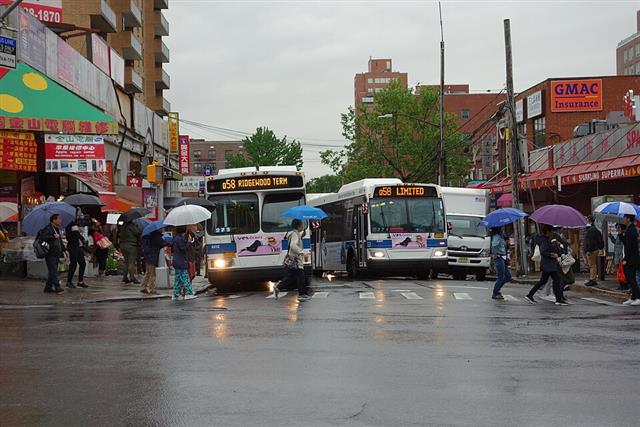
A bus route is a string of places where people gather. Every stop is a knot of waiting passengers, some stepping toward the curb as the bus approaches, some crossing behind or in front of it to reach the door. Between stops the route runs through the busiest parts of a town, past junctions, crossings, shopfronts, every stretch where pedestrians are thickest. The bus is rarely more than a few meters from someone on foot. Dense urban streets break a driver’s view with mirrors, pillars, the sheer size of the vehicle. The greater share of collisions between buses and people on foot happen there, in the thick of the crowd, as the bus pulls away from a stop into a street full of people.
At any moment the camera on the front of a bus has people in its view, often dozens of them. A bus at a busy stop can have twenty within five meters of it, boarding, alighting, passing on the pavement, none of them a danger, all of them in the sensor’s field. The overwhelming majority are in no danger whatever. They stand on the sidewalk, wait at the stop, cross with the signal well clear of the bus, walk along parallel to the road. A warning that treated every visible pedestrian as a hazard would sound without pause. The thing the system is looking for, the person on a path that meets the bus, is a rare event hidden inside a constant one. Telling the rare case from the constant background is the core of the problem.
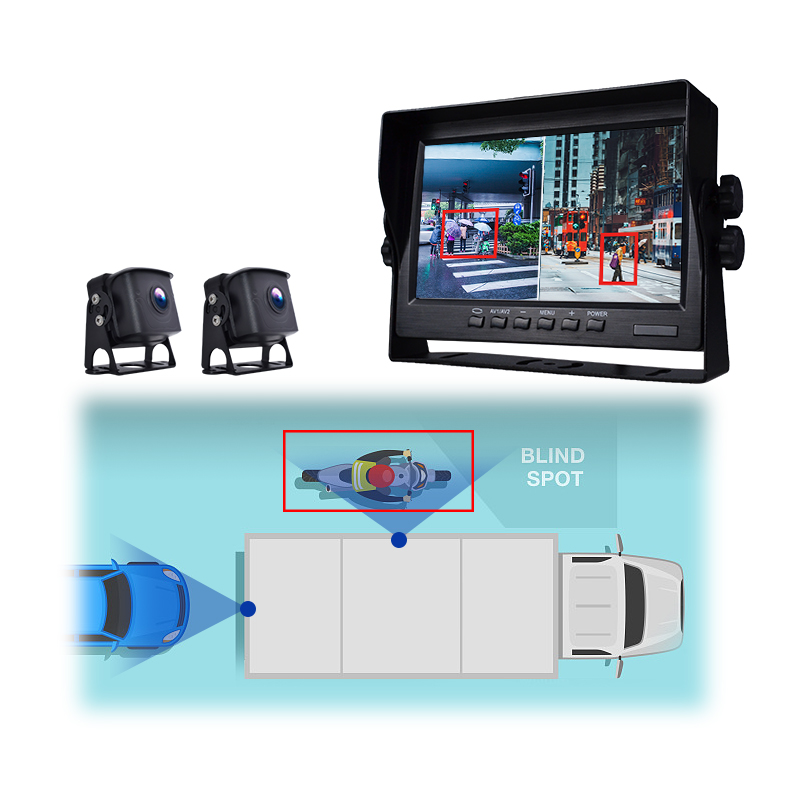
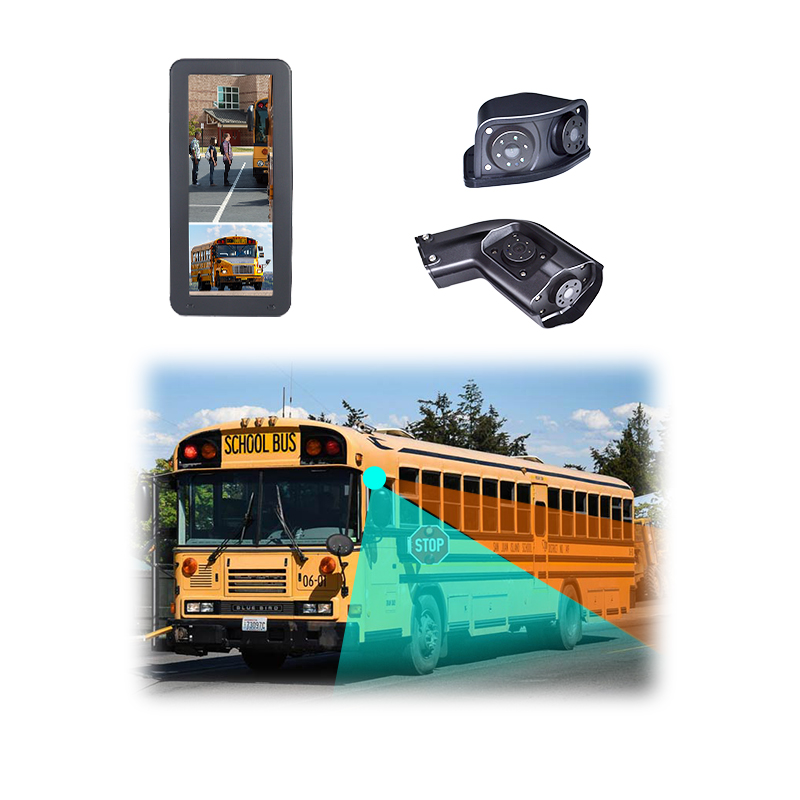
The bus makes its own blindness. It is long, tall, heavy, with a high flat front and the driver seated well back and well above the road. The strip of ground directly in front of the bumper falls below the driver’s natural sightline, as does the area beside the front wheels. A short adult can stand there unseen. A child is gone completely. At a stop the doors open into the crowd. Passengers step to the curb. Others come around the front of the bus to reach a crossing, onto the ground the driver cannot see. A pedestrian warning has to cover what the driver’s own eyes cannot, the blind strip across the front where someone can be standing as the bus takes up its load and prepares to move. The side and rear blind areas, along with the sweep of a right turn across a crossing, raise their own distinct problems, taken up with blind-spot detection.
The city bus meets the problem all day, at the low speeds of stop-and-go traffic, in the densest pedestrian settings a vehicle ever works in. The frequency is the curse. A system that must stay silent through hundreds of safe pedestrians in an hour, speaking only for the one who steps out, is held to a standard no highway sensor faces. Every safe pedestrian it correctly ignores builds no credit. The one it misses, or the dozen it falsely flags, is what the system is judged on.
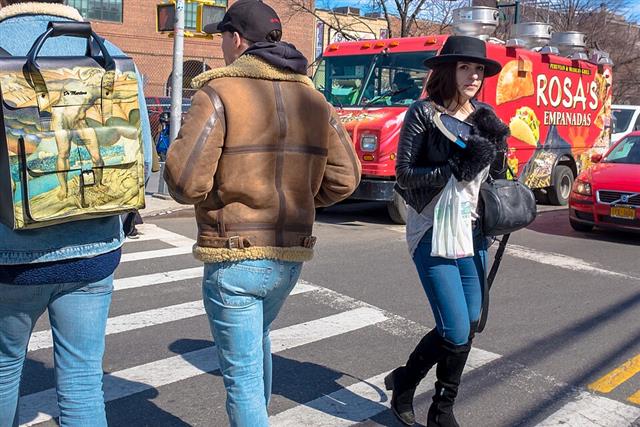
A person is far harder to pick out than a car. A pedestrian holds no fixed shape at all. The same person reads differently walking, standing, bending to a child, turning away, pushing a stroller, wheeling a case. People come in every height, build, color of clothing, in coats that blur the body’s edges, in poses the next frame undoes. A detector trained to answer one question, is this a person, has to say yes across all of that variation and no to everything else in a cluttered street. The width of what counts as a person is what makes the call so hard. The hardest cases sit at the edges of that width. A person in a wheelchair, a worker bent double over a load, a figure in a long coat or a costume, a small child whose proportions are nothing like an adult’s, all fall outside the common cases the detector has trained on heavily. A classifier raised on millions of upright walking adults can miss the shapes it met rarely. The street serves up those rare shapes every day.
Half the time the person is not fully there to be seen. A pedestrian steps out from behind a parked van, from between two waiting cars, from the far side of another bus at the stop. For the frames before they emerge the detector has nothing, no body to lock onto, no motion to track. Then a figure appears a few meters away, already moving into the road. Occlusion is the hardest of the detection failures, because it removes the time the system needs. A person tracked across many frames can be predicted. A person who appears whole from behind an obstacle, close and already walking, gives the system almost no history to judge from. The city is full of things to hide behind. A bus stop puts parked vehicles, shelters, crowds exactly where a pedestrian can step out unseen.
The other error is as common. A city is full of upright, person-sized objects that are not people. Poles, sign posts, bollards, fire hydrants, parking meters, tree trunks throw the strong vertical edges a pedestrian detector keys on. Any of them can register as a person for a frame or two. A camera knocked slightly out of alignment, by a settling suspension or a curbside knock, misreads distance and turns a far guardrail or a parked bicycle into a pedestrian-sized shape close by. Phantom pedestrians, warnings for people who are not there, are among the commonest faults drivers report on these systems. On a bus the trap is everywhere, because a city street packs more poles, posts, bollards into the camera’s view than any other road.
Detection leans on more than a single frame to beat both errors. A real pedestrian moves as one coherent body, frame after frame, in a way a flickering false edge does not. The system tracks candidates over time, builds confidence in the ones that persist and move like a person, discards the ones that strobe in and out. It uses the ground plane and the expected size of a person at a given distance to throw out a shape too big or too small to be real. Some buses add radar that confirms a solid object is moving where the camera sees a figure, the sensor mix taken up where cameras and radar are weighed. None of it closes the gap left by full occlusion. The person who emerges late, whole and close, is the one the detector has the least to work with, the one the warning can least afford to miss.
Pedestrian warning lives at the slow end of the speedometer. A city bus spends its day between a crawl and perhaps fifty an hour. The encounters that matter happen slower still, at the speed of pulling away from a stop. Low speed only seems safe. Two things turn it dangerous. The pedestrian is close, leaving the warning little distance to spend. And the deadliest bus-pedestrian case of all is the bus moving off from rest over someone standing in the front blind zone, a person the driver never saw, struck at barely any speed at all. The bus has sat at the stop as people moved around its front. It pulls away over the one who lingered at the bumper, before anyone reacts. Pedestrian warning has to work at the lowest end of the range, where the usual collision math gives it almost nothing to compute with.
The numbers are unforgiving. At twenty kilometers an hour a bus covers something near five and a half meters every second. A pedestrian who appears three meters ahead, in the path, is about half a second from contact. Half a second is less than the time a driver needs to see an alert, understand it, move a foot to the brake. A warning alone, at that range, cannot be acted on in time. The value has to come from somewhere else, from a warning given far earlier, before the bus moves, or from the system braking the bus itself without waiting for the driver. Earlier means catching a pedestrian on a converging course with the bus still several meters back, buying the seconds a low-speed contact never leaves on its own. The bus’s mass works against a late stop, because even at low speed a loaded bus carries enough momentum that the wheels cannot halt it in a meter. Slow does not mean stoppable on the spot.
This is the reasoning behind the standard that governs the case. The Moving Off Information System, written into international vehicle rules for buses and trucks, watches the forward blind zone as the vehicle prepares to pull away from rest. It asks a simpler question. Is there a person or a cyclist in the danger zone in front right now? It tells the driver before the wheels turn, with the bus still at rest and a glance still able to settle it. The rule has applied to new buses and trucks in Europe since the early 2020s, a recognition that the moving-off moment takes more vulnerable road users than any other low-speed event. City fleets have moved the same way. The bus safety standard adopted for London, for one, requires advanced braking and detection aids on new buses, with pedestrian protection at its center. The push is toward the bus itself acting at low speed, since at the moving-off moment there is rarely time for a human link in the chain. That is a different mode from a forward warning rolling at speed. A bus in service runs both, a moving-off check at zero and a forward watch at a crawl and above. The low-speed mode is where the rule and the worst accidents both fall. A warning that escalates to the brake belongs to automatic braking, a separate function.
Everything comes down to one judgment the camera cannot directly make. Of all the people around the bus, which one is about to step into its path? The cue the system would give anything for, the pedestrian’s intention, is invisible. A person standing at the curb might be waiting for the bus, waiting to cross, watching a phone, about to step out without looking, about to turn and walk away. The body gives only hints. Which way the torso and head are facing, whether the feet are squared to the road or parallel to it, whether the person drifts toward the edge or holds still, how fast, how close to the curb they already stand. From these the system builds a guess at what comes next. The strongest single cue is where the head and eyes point. A person who looks from the oncoming bus to the gap behind it is reading the road to cross. One whose gaze stays down on a phone is a different risk again, present and oblivious. The curb itself acts as a decision line. A pedestrian tracking along it, parallel, is likely to stay. One turning to square up to it, slowing, edging a foot past it, is likely to go. The system weighs these together, none of them certain, each shifting the odds. The guess has to be made before the first step off the curb, because after the step, at a bus’s speed and stopping distance, it is already too late. Reading intent early, from posture and motion alone, is the deep problem of pedestrian warning, unsolved in any complete sense. People change their minds. A pedestrian checks the road, steps back, steps out a moment later. A child darts without any of the wind-up an adult shows. A group talking on the corner reads as static until one peels away into the road. Now set that problem inside the crowd. The bus does not face one ambiguous pedestrian. It faces twenty, many giving the same weak signals, near the curb, facing roughly the road, moving a little. The system has to rank them, find the one whose posture and path say crossing among the many who merely stand near the edge, doing it continuously as the scene churns. Lower the bar for what counts as crossing intent and the warning catches the real stepper, along with a dozen people who were only standing close. Raise the bar to silence the dozen and the real stepper slips under it. No setting catches every true case and no false one, because the true case and the false one look nearly alike until the step is taken. This is the bind that defines pedestrian warning on a bus. The threat is rare, hidden in a constant crowd. The evidence for it, intention, cannot be seen, only guessed from posture before the act. The false-alarm cost is punishing, because a system that warns on the standing crowd is muted within a shift, leaving the one real warning to land in a channel the driver has already switched off. Detection, prediction, alarm economics do not just sit side by side here. They pull against each other. The bus, immersed in people and stopping slowly, sits where all three pull hardest.
An alarm is only as good as the driver’s belief in it. A warning that fires when nothing is wrong, again and again, teaches the driver first to ignore it, in the end to switch it off. On a city bus that lesson comes fast. The bus is near pedestrians constantly. A system tuned to warn on proximity alone would sound at every stop, every junction, every crowded block. Within a shift the driver reaches for the mute. A pedestrian warning that cries wolf on a bus does not merely annoy. It removes itself from service, taking the one warning that mattered down with it. Crying wolf is the failure that ends the system. It is no rough edge to be smoothed later.
The bus does, as routine, the exact thing the system is watching for. It approaches a knot of people at a stop. It pulls in close to the curb where they wait. It moves off through a crowd. Normal service looks, frame by frame, a great deal like the start of a collision. The system has to tell ordinary bus work in a crowd from the rare moment one of those people is genuinely in the path.
One answer is context. With the doors open at a stop, people around the bus are expected. A warning on every one of them would be pure noise. The system can quiet its forward alert in that state and re-arm it the instant the bus begins to move. The danger in that is plain. Quiet the alert at the stop and the one person who steps in front as the bus creeps forward can fall into the suppressed window. Where to draw that line, between the noise it must not make and the warning it must not miss, is the hardest tuning on the vehicle.
The acceptable false-alarm rate on a bus is far lower than on a car, for the plain reason that a bus meets far more pedestrians. A bus sees thousands of them a day. The same false-positive rate that gives a car driver one stray alert a week gives a bus driver one an hour, enough to kill their trust. The bus system has to be more sure before it speaks. It leans harder on confirmation, more frames, more than one cue, a path that genuinely converges with the bus, before it commits to a warning. That caution buys a lower false rate through later and fewer warnings, a trade the bus has to make further toward silence than a car would. How that rate is set and measured is its own craft, the optimizing of false-alarm rates. On a bus the dial sits where the setting is finest and least forgiving.
Getting it wrong cuts both ways. On a bus the driver’s attention makes it worse. Too loose a setting mutes the system, dead weight, the real event arriving with no alert at all. Too cautious a setting lets the stepper through unwarned. Around that sits a load no car driver carries. The bus driver is working the doors, taking fares, holding to a timetable, scanning mirrors for boarding passengers, managing a cabin full of standing people. Attention is the scarcest thing in the cab. A false alarm there is noise dropped into a task already full, cleared by ignoring the system. A true alarm has to cut through all of that in the fraction of a second it has. The warning works only as long as the driver still trusts it enough to react. Everything in the design bends toward keeping that trust intact.
For all the difficulty, the reason to keep working at it is plain. A bus is heavy, with a high flat front. A pedestrian struck by a bus goes down and under. Once down in front of a high bumper, the person lies in the path of the wheels. That, far more than the speed, is what makes a bus contact so often fatal. At the low speeds of city work the difference between outcomes is stark. Below about twenty-five kilometers an hour the great majority of people hit survive, often with minor hurt. By forty almost none escape serious injury, with around half of those impacts fatal. The bus rarely moves fast in the crowd, which places its impacts right on the edge where a small change decides everything. A warning that shaves a few kilometers an hour off the speed, or stops the bus a meter short, moves a death into an injury, an injury into a near miss. The whole apparatus, the detection that fights occlusion, the guess at intent, the alarm held back so it stays believed, exists to buy that one margin in the one case among thousands where it is real.
The system stays silent for ten thousand safe people to be ready for the one who is not.
A pedestrian warning alerts the driver that someone is in or near the bus’s path. It stops there, a sound, a light, a vibration. Automatic emergency braking goes further, slowing or stopping the bus itself when a collision looks imminent and the driver has not acted. On a bus the two often work together, the warning first, the brake as a backstop when there is no time left for a human response. The detection that feeds both is the same.
Because almost every pedestrian near a bus is in no danger at all. People stand at stops, wait at curbs, cross well clear of the vehicle. A system that warned on all of them would sound without pause. The driver would switch it off within a shift. The job is to pick the one person on a path that meets the bus, from posture, motion, position, staying silent for everyone else. Warning on the whole crowd would bury the one alert that counts.
It watches the area directly in front of a bus or truck as it prepares to pull away from rest. The space right in front of the bumper is a blind zone the driver cannot see, where a pedestrian or a child can stand unnoticed. The system checks that zone and warns the driver before the wheels turn, with the bus still at rest. International rules have required it on new buses and trucks since the early 2020s, because the moving-off moment is one of the deadliest for people on foot.
A vehicle is a rigid box with a steady outline. A person has none. The same pedestrian looks different walking, bending, turning, carrying a bag, pushing a stroller. People vary in height, build, clothing. They are small in the frame, soft-edged, often half-hidden behind cars or other people. A detector has to recognize a person across all that variation and still reject the poles, posts, bollards that share a person’s rough shape. The width of what counts as a person is what makes it hard.
That is the hardest case. A pedestrian hidden behind a parked car gives the camera nothing to see until they emerge, often a few meters away and already moving. At that range, at a bus’s speed, a warning to the driver can come too late for a human to act on. This is why the better systems try to warn earlier, on any pedestrian on a converging course, with automatic braking as the faster backstop a person cannot match. Full occlusion still leaves the least time of any case.
Because a bus meets pedestrians constantly. The same rate of false alarms that a car driver sees once a week, a bus driver would see every hour. That many needless alerts kill the driver’s trust fast. A system the driver has muted protects no one. A bus system has to hold its false rate far lower than a car’s, being surer before it speaks, even if that means warning a little later. Staying believable is as important as detecting at all.