A truck’s driver-assistance system sees the road through a camera. The camera needs light to work. At night that light is largely gone. The system that read the road all day begins to read it badly. The drop is not small. By the crash testing that rates these systems, a pedestrian autobrake system makes almost no measurable difference in the dark. The camera can no longer pick a person out of the gloom in time.
The figures behind that are stark. About three-quarters of the pedestrians killed on the road die in the dark. The death rate per mile driven runs several times higher at night than by day. For a truck the stakes sit higher again. Its longer stopping distance means it has to detect a hazard sooner. After dark its camera reaches only as far as the headlights, a fraction of its daytime range. A forward system does its worst seeing in the dark hours. That gap is not academic. A loaded truck at highway speed needs a long, clear sight line to shed its speed in time.
Night degrades a camera-based ADAS in two separate ways. Each way needs a different cure. The first is a problem of image quality. Inside the headlight beam the light is too weak, so the image turns noisy and low in contrast, and detection stays shaky even where the lights fall. The second is a hard limit. Beyond the reach of the headlights there is no light to work with at all, and no amount of tuning will move that. The two failures call for two different answers. Treating them as a single problem is the source of much of the confusion about ADAS at night.
Supplemental lighting is the obvious answer to the weak-light half. The real question is how far that carries. A lamp pushes the lit edge a little farther out. Out past it the camera has nothing to read. Genuine night capability comes from sensors that need no light to begin with.
A camera works by collecting light. The quantity it collects sets everything downstream of it. At night each pixel gathers a small fraction of the light it would collect by day. The signal falls. The sensor’s own electronic noise stays where it was. The ratio between the two collapses.
A poor signal-to-noise ratio shows up as grain, blur and flat contrast. A worn lane line that was plain by day fades into the road surface. A dark vehicle merges with the dark behind it. A pedestrian’s outline sinks into the noise. The detector is handed this degraded frame, and what it returns degrades to match.
Dynamic range is the second squeeze. A night scene sets extremes side by side: an oncoming headlight or a street lamp burning bright, a road shoulder a few meters away that is nearly black. A camera holds only so much range in one frame. Whichever way it sets its exposure, one end of the night scene is lost to the camera.
There is a further bind in how a camera fights the dark. Every way out of it costs something. Raising the gain to pull more signal from a dim scene lifts the noise by the same amount. Holding the shutter open longer smears anything that moves, the worst thing to blur on a truck closing on a hazard. The camera can buy brightness, sharpness or quietness only by spending one of the others.
None of this is a failure of the algorithm. No detector, good as it may be, can recover detail from photons the sensor never collected. The root of night degradation sits in the physical layer, in how much usable light reaches the lens. It is fixed there well before any code begins to run.
The numbers set the scale of the loss. From a bright daytime scene to an unlit road on the truck’s own beams, the light level spans many thousands to one. The camera is asked to read the same world across all of it. The dark end of that span is where the consequences run highest.

Past image quality lies a harder limit. At night a camera sees only what is lit. After dark the main thing lighting the road is the vehicle’s own headlights. The visible world ends roughly where the beam ends.
Headlight reach is finite. Low beams light the road to somewhere around fifty to a hundred meters. High beams reach perhaps a hundred to a hundred and fifty meters. The rules set only a modest floor below that. Whatever the figure, it is the camera’s working range. Where the beam lands, the camera has something to read. Past it the road is black. Black returns nothing to a camera.
For a pedestrian the numbers turn grim. By one account, under low beams a person’s whole body becomes visible only at about ten meters, and the feet out to roughly twenty-five. The distance at which a camera first picks up a walker at night can be a small fraction of the daytime figure. That leaves almost no room ahead of a heavy vehicle.
This is why a forward-collision or pedestrian warning loses its margin after dark. The warning has to fire several seconds before impact. That means catching the target far enough ahead to matter. A target outside the beam is black and goes undetected. By the time it crosses into the lit zone, the distance left in which to brake may already be gone. What limits the warning is the lit distance. Put a time on it. A warning that needs three seconds of notice needs the target lit three seconds out. At highway speed that is a long stretch of road, far past where low beams fall. A faster truck must see farther ahead.
It is the easily missed side of night degradation, because the system looks healthy. A team can tune the detector to react to fainter and smaller cues. The space past the beam still holds no information to react to. The ceiling on how far the system detects is set by how far the road is lit. A brighter algorithm cannot raise it.
Headlight type sets where that edge falls. A halogen low beam throws a shorter, dimmer pool than a modern LED or matrix headlamp. Better lamps move the camera’s working range outward with them. The beam points where the truck points, straight ahead. On a bend it runs off the outside of the curve into the dark. The camera goes blind to whatever waits around the corner, at the moment the road’s shape hides it. None of this is a software setting. Each limit is a fact of where the photons land.
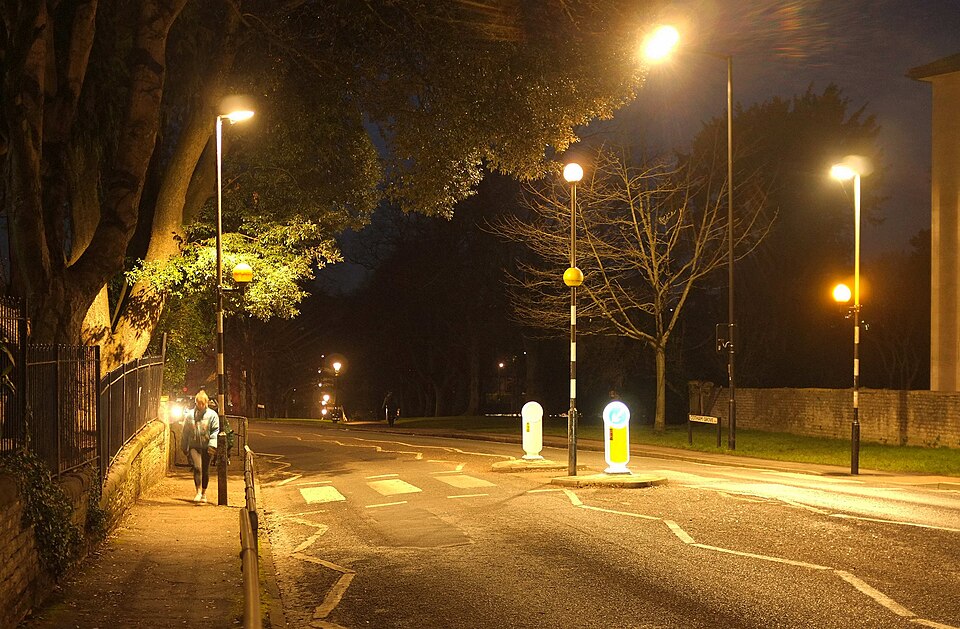
The pedestrian is the hardest night target because the difficulties pile on top of one another. A person gives off no light and is seen only by the headlight they reflect. Dark clothing reflects almost none of it. About three-quarters of pedestrian deaths happen in the dark. The motion compounds it. A pedestrian rarely waits inside the beam to be seen. They step off a kerb, cross between parked cars, move from the unlit side of the road into the lit one. By the time the body reaches the lit zone the closing distance has already shrunk. A child is smaller and shorter, set deeper into the noise, harder again to pick out of it.
The test data put it bluntly. By the crash testing that rates these systems, pedestrian automatic emergency braking makes almost no measurable difference in the dark. In one nighttime round of pedestrian autobrake tests the bulk of the vehicles scored poorly or took no credit at all. The fitted, armed hardware still cannot see the person it was bought to protect. A forward warning is built to give the driver a second or two of notice. After dark the pedestrian often becomes visible only inside that window, or after it has already closed. The system detects the person only once detection has stopped being enough.
Glare turns the screw further. An oncoming high beam, a wet road throwing light back, a bright street lamp: any of them can push part of the frame into a blown-out white. The camera’s automatic exposure then darkens everything around that white to compensate. A pedestrian can be standing in exactly the patch of shadow the camera just deepened, lost in the dark ring around the bright spot. Reflective clothing shifts the odds where a person wears it. The case the camera handles worst is a common one after dark: someone in dark clothing, off to the side, standing beyond the reach of the headlight pool.
If the trouble is too little light, the plainest fix is to add some. Fit stronger headlamps, auxiliary driving lights, an LED bar. Push the lit zone farther ahead and wider to the sides. Light reaches farther. The camera’s useful range grows with it. The higher light level inside the beam lifts the signal-to-noise ratio where the camera already sees. More sophisticated lighting narrows the gap further. Adaptive driving beam uses a matrix of segments to dim only the part of the beam pointed at an oncoming vehicle. Cornering lamps swivel light into a bend as the truck turns into it. Both are still visible light, bound by the same glare ceiling, reaching the same finite distance, leaving the same black void past their edge.
The approach helps only up to a point. Visible light bright enough to help the camera will dazzle oncoming drivers and pedestrians, the reason the rules cap headlight intensity and beam shape in the first place. Auxiliary lights are usable mainly with no oncoming traffic and at speed, much like the courtesy of a high beam. In town, in a steady stream of oncoming vehicles, they stay switched off. Town is where pedestrians are thickest.
A stronger lamp shifts the boundary of the dark a little farther out, no more than that. Power draw, heat, regulation and glare together fix a ceiling on how much visible supplemental light a vehicle can carry. Out past a hundred-odd meters the road stays black, no matter how good the lamp. Smarter aiming only spends the available light better. Even at their best, headlamps put the far edge of usable light somewhere around a hundred to a hundred and fifty meters. A truck at highway speed covers that in a handful of seconds. After every improvement, the budget of lit road the camera has to reason about is a few seconds long.
Visible supplemental light treats only the half of the problem that says the beam is too dim. The near scene grows clearer. The camera stays bound by the rule that it sees only what is lit. A driver-assistance system is sold on what it detects ahead of the truck. Visible light, in any quantity, cannot place detection where the light does not reach. It is the right tool for the near scene.
The second route lights the scene with infrared, invisible to the eye, for a camera able to register it. Security cameras do this every night: they swing the infrared-cut filter out of the optical path and switch on an 850 or 940 nanometer infrared lamp, flooding the scene with light the eye cannot sense. The appeal for a vehicle is plain: an invisible beam could light the road for the camera with none of the glare that caps the visible kind. The two wavelengths each have a catch. An 850 nanometer lamp suits the widest range of cameras and is the more sensitive option. It gives off a faint red glow a person can still see. A 940 nanometer lamp is fully invisible. Only a handful of cameras respond to it. For the same drive power an 850 source radiates something like two to three times the intensity. The catch lives inside the forward ADAS camera itself. That camera does its real work in daylight by reading color: the yellow and white of lane lines, the red and green of signals, the palette of road signs. To keep that color accurate it carries an infrared-cut filter permanently in place, screening infrared out by day. A camera built for daytime color gains nothing from an infrared lamp unless it was designed from the outset to admit infrared, through a switchable filter or a dedicated red-green-blue-infrared sensor. Neither path comes free. A red-green-blue-infrared sensor splits its pixels between color duty and infrared duty, paying for night sensitivity with daytime resolution. A switchable filter adds a moving mechanical part that has to flip at every dusk and every dawn, one more component to fail over a truck’s long service life. The infrared route asks the forward camera to be two instruments at once: a daytime color reader and a night infrared reader. Few production forward cameras carry that double duty. A handful of in-cab driver-monitoring cameras run infrared this way. The outward camera that feeds collision and lane warning rarely does. Bolt the brightest infrared illuminator onto the cab and a fixed-filter color camera still receives none of it. The filter sits in the lens and holds the infrared outside. Supplemental light closes on a bind. Visible light dazzles oncoming drivers, so the rules cap it. Infrared does nothing for the fixed-filter color cameras that typical forward systems use. Both answers run into the same limit: whatever the light, visible or infrared, the camera reaches as far as that light reaches and no farther. Stronger lamps, smarter beams, invisible infrared all push light farther into the night. None of it frees the camera from needing light in the first place. Every real night-driving fix is built to work around that single dependence.
Real night capability comes from sensors that do not lean on visible light. The first is millimeter-wave radar. It sends out radio waves and times the echo. Darkness carries no meaning for it. Night is the exact case radar is built for, one reason a capable night system usually fuses the two. The question of how to weigh one against the other belongs to its own page. Radar gives back the range and closing speed the camera loses after dark. Identifying what a thing actually is takes more than radar alone provides. Radar reads a wide scene at once, picking out returns across the road ahead. A strong echo shows where an object sits without showing what it is. A stopped truck, a sign gantry, a manhole cover each throw a return the radar has to sort out.
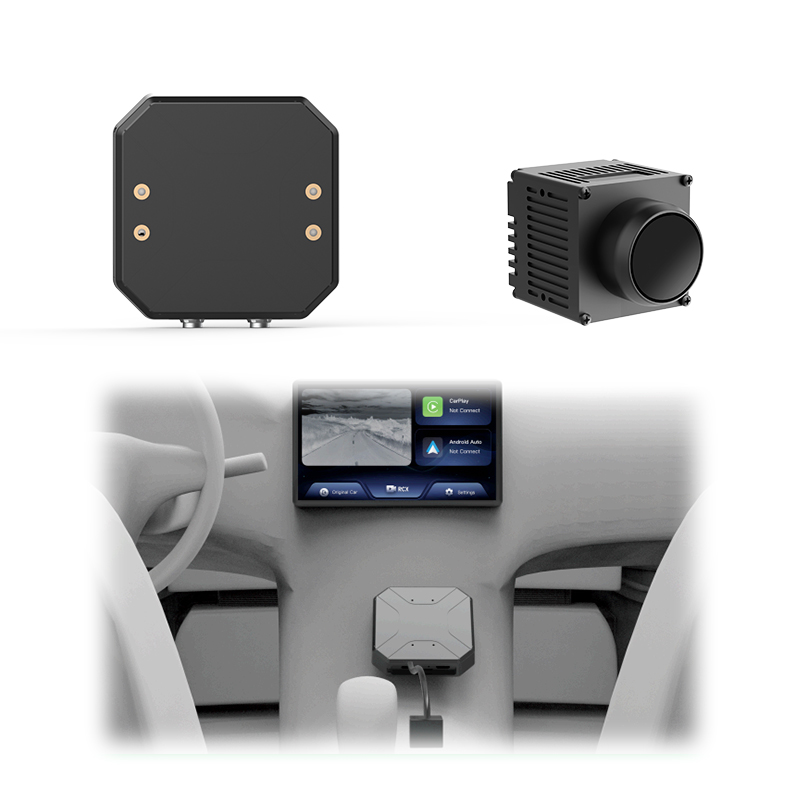
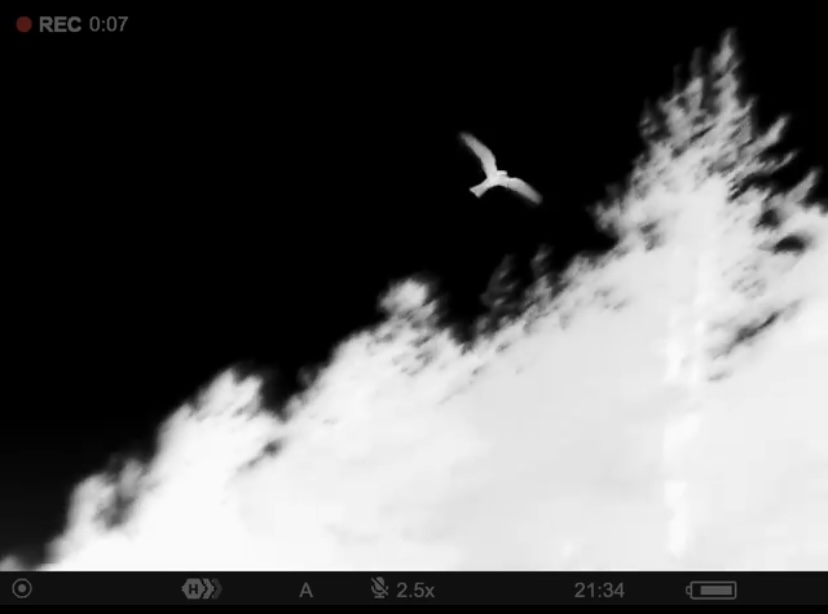
The second sensor is thermal imaging, in the far infrared. The heat a person or an engine radiates peaks in the eight-to-fourteen-micron band. A thermal camera receives that radiation passively, with no illumination of any kind. A warm-bodied pedestrian shows up as a bright shape in total darkness. That is the natural advantage of thermal for the job of finding people.
The range gap is wide. In one published comparison of night pedestrian detection, a long-wave thermal camera reached about a hundred and sixty-five meters against roughly fifty-nine for an active near-infrared camera, close to three times as far. For the deadliest night case of all, a vehicle bearing down on a pedestrian, the extra distance buys the one thing in short supply: time to brake.
Thermal carries its own costs. The microbolometer sensor at its heart is expensive. Its resolution and detail trail a visible camera. It reads no color, no lane lines and no signal lights. So it serves as a channel that needs no light, added where the camera is weakest, working alongside the camera. The usual shape of a serious night system is a color camera for daytime meaning, with radar or thermal beneath it to carry the dark.
A third route works on the visible camera itself: a back-illuminated sensor to harvest more of the scarce light, high-dynamic-range processing to hold glare in check, heavier noise reduction. These squeeze more out of the lit scene. The wall past the beam stops them as surely as it stops the lamps. They improve the weak-light half of the problem only. Every one of these night sensors has a blind spot of its own. No single one of them sees the whole scene. The blind spots fall in different places. That is the reason a serious night system carries more than one. It is built so that what defeats one sensor leaves another still seeing.
There is an operational layer under all of this. A system calibrated and validated only in daylight can miss the faults that surface after dark. A fleet running night shifts and long overnight hauls works through the very hours an ADAS is least dependable. Heavy rain and the mouth of a tunnel pile their own troubles on top of the dark, each the subject of its own page. A fleet meets the problem head on. Linehaul that loads at night, urban delivery starting before dawn, the long dark evenings of a winter route: each puts the weakest sensing into the hours that demand the most of it. Night performance is not a number that can be dialed in once the vehicle is built.
A system that works in the dark is one that took the dark into account when its sensors were chosen, its fusion was defined and its lighting was drawn. The capability has to be built into the system from the start. The test for a buyer is plain to state. Ask what the system does when the headlights are the only light. Ask at what distance it still picks up a person in that light. Only a system built for the dark can answer them. A lamp added to the front of a daytime design was never going to be enough.
Because a camera works by collecting light. At night there is far less of it. The signal each pixel gathers drops as the sensor’s noise stays the same. The image turns grainy and flat in contrast and detection grows unreliable. On top of that, a camera sees only what is lit. After dark that is mostly the area the headlights reach. Beyond the beam there is no light and nothing to detect. At night the light the software depends on is simply gone.
Only in part. Brighter visible lights extend the lit zone and raise image quality inside it, up to the point where glare begins. Light strong enough to help the camera will dazzle oncoming drivers. Auxiliary lights cannot be used in oncoming traffic. A brighter lamp pushes the edge of the dark a little farther out. Past the beam the road is still black. Lighting improves the near scene. The range limit stays where it was.
Usually it does not, because of how the camera is built. A forward ADAS camera reads color by day. That is why it carries a permanent infrared-cut filter to keep its color accurate. That filter blocks the infrared from an 850 or 940 nanometer lamp before it reaches the sensor. Infrared illumination works for cameras designed to admit infrared, such as switchable-filter or red-green-blue-infrared sensors. A fixed-filter color camera, the type in a typical forward system, receives none of it no matter how bright the lamp.
Much harder, and the difficulties stack up. A pedestrian gives off no light and is seen only by reflected headlight; dark clothing reflects little; people stand at or beyond the edge of the beam. About three-quarters of pedestrian deaths occur in the dark. In testing, pedestrian autobrake makes almost no measurable difference at night. Fitting the system does not by itself protect a pedestrian after dark.
For the dark, yes, because neither needs light. Radar sends radio waves and reads their echo, giving back range and closing speed even in the dark. Its weak point is telling what an object is. Thermal imaging reads the heat a body radiates. A pedestrian glows in total black. In one comparison it detected people at nearly three times the range of a near-infrared camera. Neither replaces the camera, which still does the daytime work of reading color. They are added beneath it for the night.
That it sees only as far as the light reaches. Image noise and glare can be eased with better sensors and processing. The hard limit is that a camera detects nothing past the lit zone. After dark that zone is mostly the length of the headlight beam. A forward warning has to pick up a hazard far enough ahead to act on it. After dark that distance is set by the lights. Extending real detection range means a sensor that does not depend on light.