








A headway warning does not wait for a crisis. It speaks before anything has gone wrong, when the truck is following the vehicle ahead too closely for the speed it is doing. The danger it watches is a steady gap held too tight, the kind that leaves no room to stop if the vehicle in front brakes hard. What the system measures is a time, the seconds between the truck and the vehicle ahead. It warns when that time falls below a set figure. The whole of the engineering sits in choosing that figure. Set it long and the warning sounds through every ordinary mile of city traffic. Set it short and it stays quiet until the gap is already unsafe.
This is a different alarm from the one that fires when a crash is moments away. That warning, forward collision, reads the gap closing fast and calls the seconds to impact. Headway monitoring reads the steady case, a gap that is not closing at all, held constant at a distance too small for safety. A truck can follow another for miles at a steady three car lengths, never gaining, no impact in sight, still one hard brake away from a crash it cannot avoid. The headway warning exists for that quiet, chronic risk, the tailgating that feels fine until the instant it does not.
Because the warning turns on a single number, the threshold, everything about how well it works is decided by where that number sits. No law of physics fixes it. A following time that is safe on a clear motorway is impossible to hold in heavy city traffic, where the whole stream runs closer than any textbook gap. A number strict enough to be genuinely safe would fire so often that drivers would mute it. A number relaxed enough to stay quiet would let real tailgating pass unremarked. The threshold is a judgment more than a measurement. Making that judgment well is the whole task.
The hard part is not measuring the gap. It is deciding how small a gap is too small.
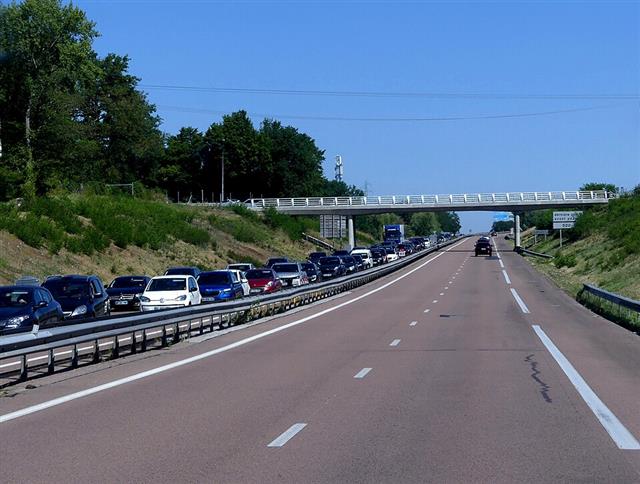
The system works with two numbers it already has. One is the distance to the vehicle ahead, read by the forward radar or camera. The other is the truck’s own speed. Headway time is the first divided by the second, the seconds it would take the truck to reach the spot the vehicle ahead occupies now. At ninety kilometers an hour, around twenty-five meters a second, a fifty-meter gap is two seconds. The same fifty meters at fifty kilometers an hour, near fourteen meters a second, is over three and a half seconds. The distance has not changed. The time has, because the speed has. The distance is not estimated from the picture alone. On a truck so equipped, the radar returns it directly, accurate to within a meter or so even in rain or dark. The system runs that division many times a second and watches the answer.
Drivers know this rule in its human form. Stay two seconds behind the vehicle in front. Watch it pass a fixed point, a sign or a shadow on the road. The front of the truck should reach the same point no sooner than two seconds later. The two-second rule is a guide to reaction time, the room a driver needs to notice a problem ahead and begin to act. It does not by itself cover the stopping. It covers the thinking. Much of Europe teaches two seconds as the safe minimum on a clear road. Some teach three to leave more margin. And the two seconds assume an ideal road. On a wet surface, in the dark, behind a vehicle that can brake harder than the truck, even two seconds can be too few. The rule is a floor for good conditions, never a guarantee.
Reading the gap is the easy part. The range comes off the same forward sensor the collision warning uses, the speed from the truck’s own data, the quotient the headway in seconds. It updates many times a second. The figure follows the gap as both vehicles speed up, slow, shift. The warning does not fire on a single low reading. A car cutting in and pulling clear drops the headway for a moment without any real danger. The system waits for the time to sit below the threshold before it speaks, filtering out the flickers that mean nothing. The threshold itself usually carries a small gap, a tighter line to start the warning and a looser one to end it, keeping the alert from chattering on and off as the headway hovers at the limit.
A time is the honest unit for this. A gap in meters means one thing at a crawl and something far more dangerous at speed. A gap in seconds means the same thing everywhere. That is why the threshold is set in time. Some systems give their first, gentlest feedback at a headway as tight as six tenths of a second, far inside the two-second ideal, because by then the gap is a present hazard, no longer a coaching note. Where exactly that line goes is the harder question.
A warning set at a fixed distance, a flat thirty meters say, goes wrong at both ends of the speed range. Thirty meters at thirty kilometers an hour is a headway of more than three seconds, a roomy gap on a slow road. A warning that fired there would nag without cause. The same thirty meters at a hundred kilometers an hour is about a second, a dangerously tight gap. A warning set to ignore it until the distance shrinks further would speak far too late. One distance cannot be right for both. The number that is generous in town is lethal on the motorway. Older following aids that worked in fixed lengths ran straight into this wall. A single distance that satisfied a highway engineer drowned a city driver in alerts. One quiet enough for the city was useless at speed.
A time threshold escapes the trap because it carries the speed inside it. Held at a second and a half of headway, the line lets the distance it demands grow on its own as the truck speeds up. A second and a half is around twelve meters at thirty kilometers an hour. The same second and a half is over forty meters at a hundred. The driver is asked for more room at speed and less in town, the meters scaling with the danger, all from one figure set in time. A second and a half behaves the same at every speed, the property that makes a time usable as a threshold. A high count tells the truck to drop back constantly. A low count barely guards anything. The unit is settled. The value to give it is the open question.
A headway warning is not a collision warning under another name. Forward collision warning asks whether a crash is coming, folding in how fast the gap is closing and how hard the vehicle ahead can brake, the full dynamics of an approach. A separate standard, ISO 15623, sets the collision warning’s trigger on those closing dynamics. A headway warning asks a flatter question: are you too close right now, at matched speed, with nothing closing at all? It is a steady-state line, a measure of how much room you keep, the companion to the collision alarm. In practice the two run together on the same truck. The headway warning works the long, chronic problem, nudging the driver to keep room hour after hour. The collision warning waits for the rare moment that room runs out. One shapes habit. The other catches the failure of habit.
Choosing the threshold is a fight between three numbers that will not agree. The first is the gap physics wants. To stop in time behind a vehicle that brakes hard, a loaded truck needs a following time well above two seconds, more than a car, more again when the road is wet or the load is heavy. By that measure the line should sit high, at two seconds or beyond. The second number is the gap drivers leave in practice. On any busy road the real following times run far shorter, often under a second in dense traffic, because that is how a packed stream moves. A driver who left a true two-second gap would have it filled by a cut-in within moments. The third number is the one the alarm can afford to enforce. A warning pinned at the physically safe two seconds, on a bus or truck in city traffic, would sound almost without pause, every block, every queue, every light, until the driver muted it and lost it for the one time it mattered. These three pull in different directions and cannot all be satisfied. A line set where physics asks is unusable in the traffic the vehicle works in. A line set where drivers already follow sanctions the tailgating it exists to cure, speaking only when the gap is so small that the warning arrives alongside the danger, too late to forestall it. The honest threshold lands somewhere in the contested middle, tighter than the textbook gap, looser than the crowd’s habit, often around a second to a second and a half for the first alert, with the gentlest feedback reaching down toward six tenths where the gap turns plainly unsafe. That number is argued into place, weighing how much nuisance a fleet will tolerate against how much risk it will carry. It encodes, in a single figure of seconds, a judgment about acceptable danger that no equation can settle. In practice a fleet finds the number by trying one. It sets a threshold and watches how often the warning fires across a week of real routes. The line shifts until the rate sits where drivers will still heed it. The data decides less than it seems. Two fleets with the same trucks on the same roads can land on different numbers, because they weigh nuisance against risk differently. A headway threshold is a value put into numbers. The value is where the real work is.
The time unit already does part of the scaling. Because the threshold is in seconds, the distance it asks for stretches with speed on its own. The acceptable time itself is not constant either. On an open highway a second and a half is a sane floor the warning holds the driver to. In stop-and-go city traffic no one keeps a second and a half. A warning that demanded it there would be pure noise. For that reason the time threshold is itself varied by speed or operating mode, or the function switches off below a city speed.
The low-speed end is the harder one. Below something like thirty or forty kilometers an hour, following is tight by nature. Cars sit close in queues, creep through lights, pack together at junctions, none of it a fault of the driver, all of it far inside any highway gap. A headway warning run at full strictness through that would fire on every block. The common answer is to stand the function down below a set speed, treating it as a highway and open-road aid, or to loosen the threshold as speed falls, letting the line track what is reasonable at a crawl. Standing it down in town has a logic beyond nuisance. At a crawl the stopping distance is short and a small gap is survivable, leaving the chronic risk the warning guards against smaller there in any case. Either way the system stops pretending that a motorway gap belongs in a city queue.
At the other end the gap matters more than anywhere. At motorway speed the stopping distance grows with the square of the speed. A doubling of speed roughly quadruples the distance needed to stop. The same one-second lapse that is recoverable at fifty is a crash at a hundred. The same following time now covers far more ground and far more risk. This is where the threshold bites hardest. Some systems tighten the required seconds further at the highest speeds, adding reaction margin where a mistake is least survivable.
Speed is not the whole of the context. A coach cruising an intercity motorway and a city bus working a high street face different following worlds, the right threshold differing with them. Some systems read the road class from the map or the speed pattern and pick a matching profile, a tighter line for the open road, a looser one or none for the urban crawl. Others let the operator choose a profile to suit the route. The threshold is rarely a single setting, more often a small set of them, each chosen for where the vehicle runs. Trimming those settings against the alert rate they produce is its own discipline.

A loaded truck does not stop like a car. Forty tonnes at speed carries many times the energy of a car at the same speed. Every bit of it has to be shed through the brakes before the vehicle halts. The distance that takes runs far longer than a car’s, growing with the square of the speed. A laden truck stopping from a hundred needs well over twice the forty meters a car takes. The gap a truck needs behind the vehicle ahead is set by that longer stop.
The familiar two-second rule is a car rule. A laden truck at two seconds has no room to stop behind a vehicle braking hard ahead, because its stop runs longer than a car’s, the reaction time no different. By the physics a heavy vehicle wants three seconds or more, a second past the two a car needs. A headway threshold built for a truck should sit wider than a car’s, the extra second a direct answer to the extra stopping distance the mass demands.
The truck shares the road with those cars all the same. A stream of traffic flows at the gap cars keep, near a second or less in density. A truck trying to hold its safe three seconds finds the space filled by a car cutting into it almost as fast as it opens. A warning that demands that wide gap tells the truck it is too close through much of its working day, in traffic where the wider gap cannot be held. The commercial threshold fights the same nuisance battle a car’s does, harder, because the gap physics asks of a truck is further still from the gap the road allows it.
Better systems do not use one threshold for laden and empty alike. They read the axle weight or the load and widen the line when the truck is heavy, tightening it back as the trailer empties, the warning tracking the mass the brakes have to fight. A long descent moves the line again, the brakes warming and fading on the grade, the safe gap growing where a flat-road number would fall short. The threshold that fits a full truck on a downgrade is far wider than the one that fits the same truck empty on the level.
On a bus the gap carries a second cargo of risk. The passengers are standing, holding a rail, moving down the aisle. A hard stop to recover a gap that closed too far throws them forward, an injury the truck never has to weigh. So a bus has reason to keep more room than its own stopping distance alone would ask, enough that the brake need never come on hard. The headway threshold on a bus answers to the people inside it and to the vehicle ahead alike.
A headway warning rarely speaks in one voice. It grades its response, a soft signal first, a hard one later. The first stage is a coaching nudge, a quiet light or a gentle tone at a looser headway, telling the driver the gap has slipped below comfortable without any emergency in it. The soft stage often shows more than it sounds, a steady amber car-icon on the display that brightens as the gap tightens, ignorable until the second stage breaks in with a tone the driver cannot tune out. The second stage is a real warning, louder and sharper, at a tighter headway where the gap has become a present danger. A common shape is a monitoring prompt that asks the driver to pay attention and prepare to ease off, followed by a stronger alert if the gap keeps shrinking. One number does not carry all of that. The grading needs a line for each stage, the looser one set where coaching helps, the tighter one set where the danger is real.
Whether the driver can move the line is its own question. A driver allowed to set the threshold is tempted to loosen it until the warning falls silent, which defeats the point. A locked single setting may misfit the route. Many fleets take the choice out of the driver’s hands, fixing the threshold by policy or letting a manager pick a profile for the vehicle, leaving the driver only the gap to keep. Operational-vehicle rules in some markets put a floor under the question by requiring the warning to be fitted on commercial fleets at all, with the compliance detail belonging to the standard that governs it. A mandate to fit it matters because the protection a fleet would drop to save cost is exactly the protection the hardest-run vehicles need.
The headway warning is the first tier of a taller stack. It works the chronic problem, the gap held a little too tight for mile after mile, nudging the driver to drop back before anything goes wrong. When the gap is no longer merely tight and starts closing fast toward the vehicle ahead, a different alarm takes over, the forward collision warning reading the closing and calling the seconds to impact. Past that, the automatic brake can act on its own. The three sit in order, headway monitoring keeping room, collision warning catching the moment room runs out, braking as the last resort. The headway threshold is the line that, held, keeps the truck from ever needing the two that follow. A headway threshold set well does its best work invisibly, keeping the gap wide enough that the collision warning and the brake almost never have cause to fire.
All of it rests on the driver still believing the gentle stage. A coaching nudge that fires too easily becomes background noise. A driver deaf to the soft signal is half deaf to the hard one behind it. The threshold for the first stage has to be loose enough that it speaks only when the gap has genuinely slipped, rare enough to keep its meaning. A first stage set too eager collapses the whole graded scheme into one ignored buzz. The art of the headway warning is two thresholds that each stay believable, the soft one trusted enough to act on, the hard one rare enough to alarm.
Everything about the headway warning comes back to a chosen number. The number is a judgment more than a fact. It says how much chronic risk an operator will run against how much nuisance it will lay on its drivers. Two careful fleets, the same trucks on the same roads, can settle on different thresholds and both be right, because they weigh those two costs differently. No equation hands the number over. Physics asks for a wide gap, the road cannot allow it, and the driver needs the alarm quiet enough to live with. The threshold is where those three arguments are made to settle, set deliberately, scaled to speed and load, graded from a nudge to an alarm, trimmed until it stays believed. The fleets that get it right treat the threshold as a deliberate policy, revisiting it as their routes, loads, crash record teach them where the line belongs. A factory default, left untouched, is a number no one chose, fitting no route in particular. Done well, the threshold is invisible, a line the driver rarely meets because the habit it built keeps the gap open. Done badly, it is either off or ignored, which come to the same thing.
No number is the right one. There is only the number a fleet can defend.
A forward collision warning fires when a crash is close, reading how fast the gap to the vehicle ahead is closing and calling the seconds to impact. A headway warning fires earlier, on a different problem. It watches a gap that is not closing at all, held steady at a following time too short for safety. One catches the moment a crash becomes likely. The other flags the chronic habit of following too close, the tailgating that is fine until the vehicle ahead brakes hard. They run together on many equipped trucks.
Because a distance in meters means different things at different speeds. Thirty meters is a roomy gap at city speed and a deadly one at motorway speed. A following time, the distance divided by the speed, stays meaningful everywhere. A second and a half is a second and a half whether the truck crawls or cruises. The distance it stands for grows on its own as the truck speeds up. Setting the threshold in seconds lets one number hold the line correctly across the whole speed range.
There is no single correct figure. The familiar two-second rule is a guide to reaction time, taught across much of Europe as a safe minimum on a clear road, with some teaching three seconds for more margin. In practice, systems set their first gentle feedback at a tighter gap, some as low as six tenths of a second, where the following time has become a present hazard. The right threshold for a given vehicle depends on its speed, its load, the traffic it runs in, the reason it is a tuned setting more than a fixed law.
Often not. Many fleets lock the threshold by policy or let a manager set a profile, leaving the driver only the gap to keep. The reason is plain. A driver able to loosen the line is tempted to loosen it until the warning falls silent, the opposite of the point. In some markets the rules for operational vehicles require the warning to be fitted on commercial fleets, putting the protection in vehicles that might otherwise have gone without it. Where adjustment is allowed at all, it usually sits with the operator. The driver at the wheel does not get it.
Because city following is naturally tight. In queues, at lights, through junctions, the whole traffic stream runs at gaps far shorter than any safe highway figure, with no fault on the driver’s part. A threshold strict enough for the open road would fire on nearly every block. Good systems handle this by easing the threshold at low speed or standing the function down below a set speed, treating it as a highway aid. If the warning still nags constantly in town, its low-speed behavior is set too strict for the traffic the vehicle works in.
Yes. A loaded truck takes far longer to stop than a car, its stopping distance growing with the square of the speed and with the weight the brakes must shed. The two-second rule is a car rule. A heavy vehicle needs three seconds or more for the same safety, putting its headway threshold wider than a car’s. Better systems read the axle load and widen the line when the truck is heavy, narrowing it as the trailer empties. A long downhill, where the brakes warm and fade, calls for more room again.