

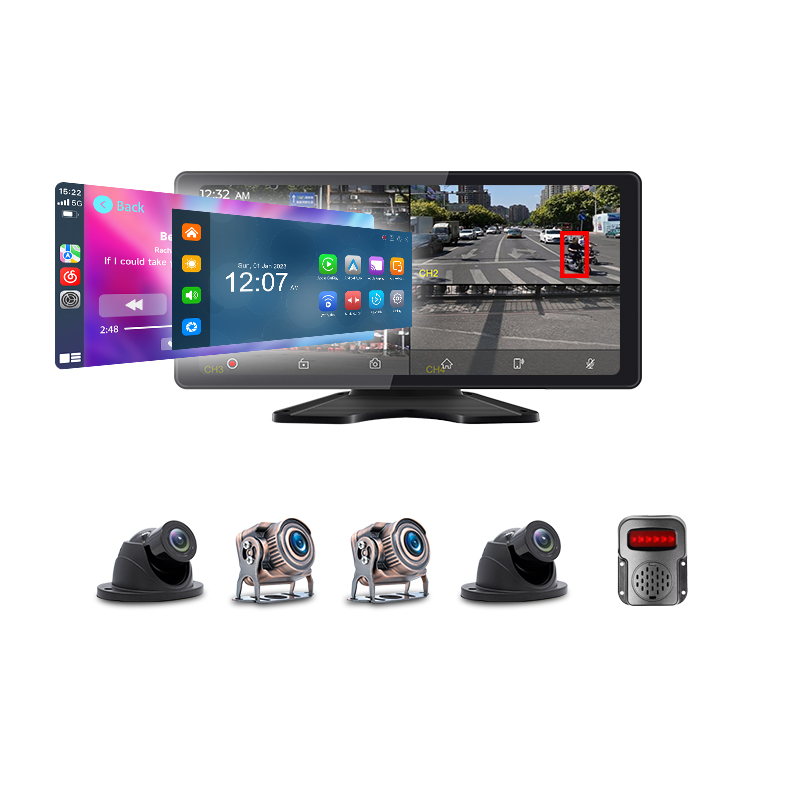

A lane departure warning watches one thing, the painted line at the edge of the lane. It answers a single question about that line ten times a second. Will a wheel cross it within the next second or two? The camera never sees the road the way a driver does. It sees a band of brighter pixels on darker tarmac, fits a line through them, and reads how fast the truck is sliding toward it. From that slide it computes a time, the seconds left before a tire touches paint. When the time runs short with no indicator lit, the system speaks. The work is in telling a drift the driver never meant from a lane change the driver did, a true line from a tar seam that only looks like one.
Forward collision watches the gap straight ahead, the truck closing on what it follows. Lane departure watches the other axis, the truck sliding sideways out of the lane it sits in. One danger runs along the road, the other across it. The sensors split along the same divide. Forward warning leans on radar. Radar ranges a closing object in any light. A painted stripe throws back no radar echo a system can use. Lane departure is a camera job from start to finish, because the thing it tracks is a mark on the road surface that only a lens can see.
The departures that matter are the ones nobody chose. A tired driver on a long night haul drifts a few degrees off straight. A glance held too long at a mirror lets the truck wander wide on a gentle bend. These slow unmeant slides toward the line are what the warning exists to catch. A driver who signals and changes lane on purpose moves the same way the camera sees, toward a line and across it. The system has to separate the meant from the unmeant, reading the wheel, the stalk, the way the whole truck moves.
Finding the line is the easy half. Reading what the truck means by crossing it is the hard half.
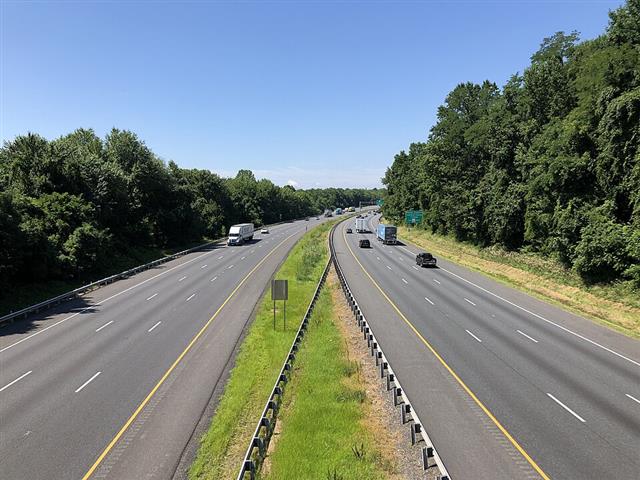
The camera sees a grid of brightness values. The lane marking is a run of bright ones laid over the darker gray of the tarmac. Paint is built for that contrast. White on asphalt, yellow on pale concrete, the marking is made to stand out to a human eye at night, the same property that makes it stand out to a sensor. The first step in recognition is finding the places where brightness jumps, the edges of the bright band, where a few pixels of dark road give way to a few of bright paint. An edge detector marks every such jump in the frame. Plenty of those jumps belong to no line at all, the shadow of a tree, the lip of a pothole, the chrome of a passing car.
The next step turns scattered edge points into a line. The system fits a model through them, a straight line on a straight road, a low curve where the road bends. A common method gathers the edge points that fall along a plausible boundary and solves for the line or the gentle arc that best runs through them. A dashed marking is a row of separate blocks with bare road between them. The model bridges the gaps, reading the dashes as samples of one unbroken edge. Two such edges, one to each side, fix the lane the truck sits in.
The system reads type and color off the same line. A solid marking and a dashed one carry different rules, one forbidding a crossing, the other allowing it. A warning that respects the difference has to know which it is looking at. The camera meets the lines in perspective, the two boundaries converging toward a point on the horizon, near paint wide in the frame and far paint pinched thin. To measure a real sideways distance the system warps the image to a top-down view, the inverse-perspective transform, where the converging lines stand parallel again and a meter on the road maps to a fixed span in the picture near or far.
None of this restarts each frame. Once the lines are found the system tracks them, predicting where each will sit in the next image from where it sat in the last, correcting the guess against the fresh edges. The tracking smooths the jitter of a single noisy frame. It carries the lane across a stretch where the paint thins to nothing for a moment. A boundary held in memory stays steadier than one found cold thirty times a second.
The road carries many lines that are not lane lines. A tar seam, the black sealant poured into a crack to keep water out, runs for meters in a dark band with two clean edges, the same signature an edge detector reads off real paint. A marking painted over in a re-stripe leaves a ghost the camera half-sees under the newer one. A patch of fresh repair against old surface, the joint between two paving runs, a long oil stain down the lane, each throws an edge that can line up where a boundary would sit. The detector finds all of them. Sorting the real markings from the rest is the larger part of what separates a working system from one that warns at random.
Shadows are the hardest of the false lines. A row of trees or a guardrail throwing bars across the lane leaves strips of sunlit road between strips of shade. A long bright strip framed by two dark ones can match a true marking in both its width and the sharpness of its edges. On brightness alone the lit gap and a painted stripe look the same. A low sun behind the truck stretches these bars far down the lane. The system reads a boundary that is not there, set at an angle the real lane never takes. Construction zones double the trouble, the old markings left faintly visible under temporary ones in a clashing color, two sets of lines at once for the camera to choose between.
The system leans on the ways a real line behaves that a stray edge does not. Width is the first test, a marking holding to a known breadth that a too-thin seam or a too-broad patch fails. Persistence is the second, a true boundary moving smoothly across frames as a shadow swings with the sun angle or the truck’s heading, the flickering candidate dropped before it raises a warning. Geometry is the third, a lane carrying two boundaries a sensible distance apart, a lone line with no partner across the road left in doubt. Post-processing filters weigh the three together, building confidence in a line over many frames before the warning logic trusts it. The filtering never reaches perfect. The failure that bites is the confident false line, a seam or a shadow read as paint under the wheels, firing a warning at a truck sitting square in its lane. A few of those in a shift send a driver reaching for the off switch, the muting that follows any alarm crying wolf too often. Holding the false-line rate down is its own tuning problem, taken up where false-alarm rates are set.
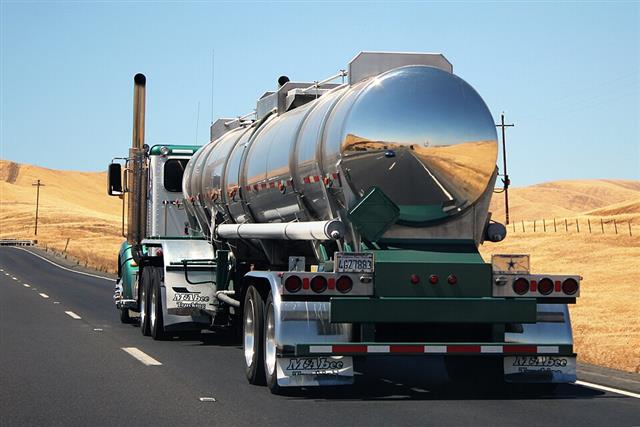
With both boundaries found, the system knows where the lane edges run in front of the truck. The question that follows is where the truck sits inside them. It measures the lateral offset, the sideways distance from the truck to each line, the room left on the one side set against the room left on the other. A truck centered in its lane reads two equal offsets. One drifting toward the right line reads a shrinking gap on that side and a growing one opposite. That offset is the figure a departure is measured from.
Reading the offset right needs the truck’s own shape. The camera looks forward from near the top of the windscreen, set off from the truck’s centerline and mounted high above the wheels. A system carries a fixed model of the vehicle, its width, the camera’s place on it, the track of the wheels. From that model it projects the body down onto the road plane to know where each side of the truck falls against the painted lines. What must not cross the line is a tire. The point the system defends is the edge of the contact patch on the road.
The space between the two boundaries is the lane width, a figure the system reads for itself and never assumes, because lanes do not come in one size. A motorway lane runs wider than a lane on an old rural road. The usable room is what remains once the truck’s width is taken out, divided to either side. A truck about two and a half meters wide in a three-meter lane is left around a quarter of a meter of slack on each side before a tire meets paint. The same truck in a lane of three and three-quarter meters has better than half a meter. A lane that narrows at roadworks or widens into a slip road moves the margins under the truck without the truck moving at all. The system has to follow the real lines on the road.
The offset is never still. It updates every frame as the truck tracks left or right of the lane center, the live reading the warning logic watches. On a straight road the math is plain, the lane center a straight line and the offset a simple sideways distance to it. A bend breaks that simplicity. The lane center curves. The truck’s distance from it has to be measured against a curving reference the camera builds from the same painted lines. Reading the offset through a curve is where the next hard problem starts.
A truck sits in its lane with little room to spare. Set a body close to two and a half meters across into a lane built for mixed traffic. The slack falls to a handful of centimeters on each side. The same sideways drift a car rides out with paint to spare puts a truck’s tire on the line. Departure, for a truck, begins from a position already near the edge. The warning point arrives sooner at the same rate of drift. The system has less distance to work with between a centered truck and a crossed line. The road can shrink the margin further. Older routes laid out for narrower vehicles, work zones that jog the lane sideways, mountain passes with lanes pinched against the rock, each leaves a wide truck with almost nothing between its tires and the markings. A driver doing nothing wrong, holding a steady line down a lane that never gave a wide truck much room, can trip the warning again and again. What trips it is the lane itself. That nuisance is the cost of timing a warning for a margin that was small to begin with.
An articulated truck does not track like one rigid shape. Through a bend the trailer’s wheels follow a tighter arc than the tractor’s, cutting inside the line the cab takes, the rear of the rig riding closer to the inner edge than the front. This off-tracking lets the trailer reach the inside marking with the cab still sitting centered in the lane. A camera at the windscreen sees where the cab is. Where the trailer has gone is hidden from it. A system either carries a model of the trailer’s swept path or watches only the cab’s own position. The difference between the two is a stretch of the truck the lateral reading does not directly see. How much of the trailer the system accounts for is a design choice. The plainest version marks the warning to the cab alone, quick to build and blind to everything behind the kingpin. A better one estimates the trailer’s angle from the articulation joint and swings its idea of the swept path with it, catching the rear before it crosses what the cab cannot. Wind adds another push. A high-sided trailer takes a crosswind like a sail, drifting downwind in a steady lean the driver holds a correction against, a slow sideways movement that can read to the camera as the start of a departure. The wide vehicle meets the line earlier than the car the warning was first drawn up for, from more directions at once.
Offset alone does not say when. A truck sitting a hand’s width from the line is in no danger if it holds that line down the road. A truck sitting dead center, sliding fast toward one side, is closer to trouble than its position lets on. The quantity that fuses position with motion is the time to line crossing, the seconds left before a tire reaches the paint at the rate the truck is moving sideways now. It is the lateral twin of the forward time to collision, computed in the same spirit, by asking how long a closing gap has left. When the road runs straight and the drift is gentle, the figure takes a plain form, the sideways distance left to the line divided by the sideways speed toward it. Half a meter of room closing at a quarter meter a second is two seconds of warning left. The same half meter closing at half a meter a second is one second. The system figures this many times a second and watches the value fall. A warning fires when it drops through a set threshold, a value counted in time. Held in time, the threshold means the same thing whether the truck creeps toward the line or rushes it. Production systems put that threshold near and below a second. The international standard for lane departure warning frames the trigger as a zone with two edges. The earliest the system may speak is a set distance short of the line, still inside the lane, that distance growing the faster the truck is leaving, from around three-quarters of a meter on a slow drift to near a meter and a half on a quick one. The latest it may wait is a fixed distance past the marking, close to a meter for a truck, about a third of that for a car. The faster the departure, the earlier the allowed warning, the zone stretching toward the lane center with the rate of crossing. Two things make the real computation harder than the plain division. The first is the truck’s own angle. A vehicle yawed a few degrees across the lane reaches the line with one front corner first. The crossing point and the crossing time are set by the leading tire. The shape the system solves for is a wide rigid body meeting a line at an angle. The second trouble, the worse one, is the bend. On a curve the line the truck is closing on is itself curved. A time to line crossing read off a straight-ahead extrapolation aims at a boundary the lane does not follow. A system has to project the truck’s path along the curve it estimated back in the detection step and find where that path meets the curving edge. The whole figure rests on the curvature the camera fitted to the lane. A curve gotten wrong, in faded paint or a tightening bend, drags the time to line crossing wrong with it, firing early on a truck that was tracking the lane fine or staying silent as one runs wide. The honest seconds the warning depends on are only as good as the lane the camera believes it is in.
The same motion carries two meanings. A truck eases across the line into the next lane. The camera sees that crossing the same way whether the driver chose it or the truck wandered there unwatched. A deliberate lane change and a fatigue drift trace the same path in lateral terms, the same offset growing, the same time to line crossing running down. Nothing in the geometry tells them apart. The system needs a separate signal of intent, something outside the camera’s read of the road, to know which crossing to warn about.
The cleanest signal of intent is the indicator. A driver who means to change lane reaches for the stalk first. The system takes that as the answer: indicator on for the side of the departure, no warning. The crossing was declared. Standards for heavy vehicles state the rule plainly, the warning held back when the correct turn signal is lit. The function does not fight a driver doing exactly what the law asks. The execution detail of that rule sits with the compliance steps for the operating standard, a separate matter from how the suppression is wired.
Drivers forget. A lane change made without a flick of the stalk is common, on an empty motorway at night above all, where there is no one to signal to. The system cannot tell that unsignaled deliberate change from a genuine drift, because in the road geometry they are the same event. It warns on both. The warning on a deliberate unsignaled change is the system doing the one thing it can, treating every unsignaled crossing as a departure and letting the alert double as a reminder that the stalk went untouched. A driver who signals is a driver the warning leaves alone.
Some systems look past the signal to the controls. A deliberate lane change comes with a deliberate hand, a firm turn of the wheel, a steering torque with a clear shape and timing. A fatigue drift comes with slack hands, little correction, the truck falling toward the line under camber or crosswind with no steering to match. A system that reads the wheel can tell a driven maneuver from a passive slide and hold its warning for the driven one even when the stalk stayed untouched. The gain is fewer nags on a brisk unsignaled change. The risk is real: a drift that happens to carry some steering, or a driver slumped against the wheel, can read as deliberate and lose the warning that was the point.
Where to set that balance is the heart of the intent problem. Warn on every unsignaled crossing and the truck nags a driver who rarely signals on a bare road, the alarm wearing thin until it is switched off, the one real drift then landing in a channel already ignored. A system that suppresses too freely on the strength of a little steering lets a true departure slip through unwarned. The choice between nagging and missing is the one every alarm threshold faces, the work of holding false alerts down without dulling the real ones, taken up where alarm rates are tuned. What stays fixed under all of it is the evidence. The indicator is a fact the driver gave. Everything else, the steering, the sharpness, the path, is the system inferring intent from how the truck behaves.
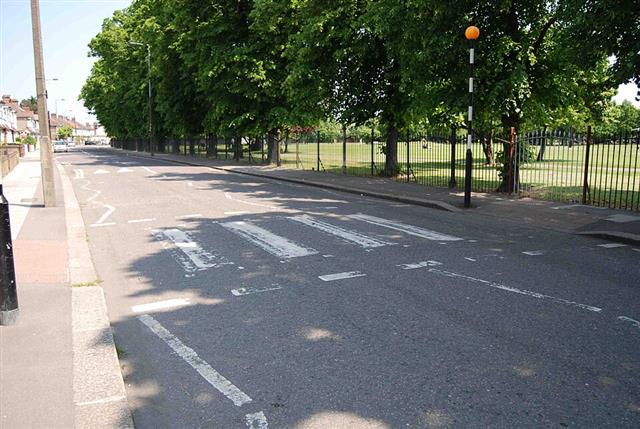
The whole chain rests on paint a camera can see. Take the marking away and the first step has nothing to find, the steps after it nothing to stand on. Worn rural roads are the common case, the paint scrubbed thin by years of tires and weather until the line is a faint, broken trace. The detector half-finds it, a few edge points here, a gap there, a boundary that fades in and out frame to frame. A line the tracker cannot hold is a line the warning cannot trust. Many of the roads a working truck covers are exactly these, county routes and industrial approaches where the paint was last fresh a decade ago. Where the marking has gone entirely, painted over once and never refreshed, there is no boundary to read at all.
Weather and light take the line away as surely as wear. Snow lays a white sheet over the lane and the markings under it vanish. Standing water throws the low sun straight back into the lens and washes the contrast flat. A wet night does both at once, the road a mirror of headlamps with the paint lost somewhere beneath. Darkness alone shortens how far ahead the camera reads the line, a limit taken up with the night performance of these systems. Heavy rain blurs and scatters the image, a loss handled where rain is taken up. Each of these is the same wound to the same first step, the bright band the detector hunts for buried under snow, glare, spray or dark.
A camera that cannot see the line must not invent one. The honest response to lost paint is to lower confidence and step back, the system telling the driver that lane departure is unavailable. A warning that fired on snow glare would train the driver to ignore it. One that went quiet without saying so would leave the driver trusting a watch that had stopped. A lens fouled by road grime, a sticker, a smear of winter salt, blinds the camera as completely as missing paint. The better systems watch their own image quality and flag a dirty or blocked view the same way they flag a missing line. The limit underneath is plain. No visible marking, no lane departure warning. On a road that was never painted, a worn back lane or a yard, the function has nothing to work from and says so.
Everything the warning knows comes from the line. What it cannot say is what lies past the paint, a hard shoulder, a drop, a barrier, oncoming traffic, or open road that costs nothing to drift onto. The same warning fires for a wander toward an empty verge and a wander toward a cliff, the line the only thing it reads, what waits beyond it outside its world. It cannot see an unmarked edge, the lip of a rural road with no paint at all. It does not know whether the lane it found is the right one, only that a marked boundary is near. A driver still owns the lane. The warning is a prompt at the edge of attention. The system flags the line. The correction stays the driver’s. Lane departure recognition is the narrow, honest skill of telling where the truck sits against the paint and how fast that is changing, no more.
It reads the line and reads only that. What the paint leaves unmarked stays invisible to it.
Lane departure warning tells the driver a wheel is nearing the lane line. It stops there, a sound, a light, a buzz through the seat or wheel. Lane keeping assist goes one step on, nudging the steering to bring the truck back. One alerts. The other acts. The recognition underneath is the same, the camera finding the line and measuring the truck’s distance to it. What differs is what happens once a departure is judged near.
Two causes are common. The camera can read a false line, a tar seam, a shadow cast across the lane, or an old marking left from a re-stripe, warning against a boundary that is not real. The other cause is room: the lane is narrow, the truck is wide, an ordinary safe position sitting close to the paint. A wide vehicle on a tight road trips the warning more often for this reason alone.
It works in both as long as the camera can still see the line. Darkness shortens how far ahead it reads the paint. Heavy rain and the glare off a wet road can wash the line out of the image. When the view drops too far, an honest system lowers its confidence and tells the driver the function is unavailable.
The turn signal suppresses it. When the indicator for that side is on, the system reads the crossing as intended and holds the warning back. The rules for heavy vehicles require this. The function does not fight a signaled lane change. A driver who changes lane without signaling will still get a warning, because the camera cannot tell an unsignaled deliberate move from a drift. The alert doubles as a reminder that the stalk went untouched.
On heavy vehicles the function is set to switch on at higher road speeds, with the international rule activating it from around sixty kilometers an hour upward. Below that, in town traffic and at junctions, lane changes and tight maneuvers are constant. A lane departure alert there would fire without pause. The warning is held for the open-road speeds where an unmeant drift is the real risk.
No. The whole method rests on a marking the camera can see. Where the paint is worn to a faint trace, the system finds a weak, broken edge it may not trust. Where there is no marking at all, on an unpainted back road or a yard, there is nothing to read and no departure to flag. Faded and missing paint marks a plain limit of the function. It is no fault in the system.